











You Don’t Have a Skill. You Have a Novice.
Blog: Blog | Process Street | Compliance Operations Platform
You don’t have a skill. You have a novice.
My team keeps telling me they’ve “built a skill.” One person gave Claude a short prompt and hit create. Another found something on a marketplace and installed it. Both walked away thinking the job was done.
It wasn’t. They didn’t build anything. They downloaded a stranger and handed it the keys. And the stranger is kind of an idiot.
People treat AI skills the way we used to treat WordPress plugins or App Store apps. You install it, it handles every scenario, and it performs the way you expect. That mental model made sense for traditional software, where teams tested thousands of edge cases before shipping version 1.0.
AI skills don’t work like that. When you create a skill for the first time or download one from a marketplace, it’s untrained. It has never encountered your business context, your edge cases, your preferences, or your definition of “good.”
The split most people miss
There are two types of AI skills, and the difference matters more than most people realize.
Generic skills work reasonably well out of the box. “Run an SEO audit on this website.” “Summarize this article.” “Generate a compliance checklist.” These are tasks with broadly consistent expectations. The skill doesn’t need to know you or your business to do an adequate job.
Context-dependent skills are a completely different story. “Write a social update in my voice.” “Prepare my weekly board report.” “Draft a customer email that sounds like me.” These require deep knowledge of your tone, your audience, your standards, and your product. For compliance teams, the stakes are even higher: an untrained skill producing inconsistent audit reports is worse than no skill at all. A fresh skill will produce something that reads like AI generated it, because AI did generate it, without the hundreds of micro-corrections that shape output into something that reads like you wrote it.
Andrej Karpathy coined “vibe coding” in February 2025 to describe a world where you “fully give in to the vibes, embrace exponentials, and forget that the code even exists.” A year later, he walked it back. The vibes weren’t enough. Production requires structure.
The same principle applies to AI skills. The initial creation is the vibe. The training is the structure.
What training actually looks like
The gap between a novice skill and a hardened skill is the gap between a new hire on day one and that same person after a year of direct feedback.
The skill has to learn what “too formal” means for your brand. What “too long” means for your audience. Which edge cases to handle and which to flag. What your definition of done actually looks like. Production-ready skills handle branching paths the same way conditional logic in workflows routes tasks based on real inputs, not assumptions.
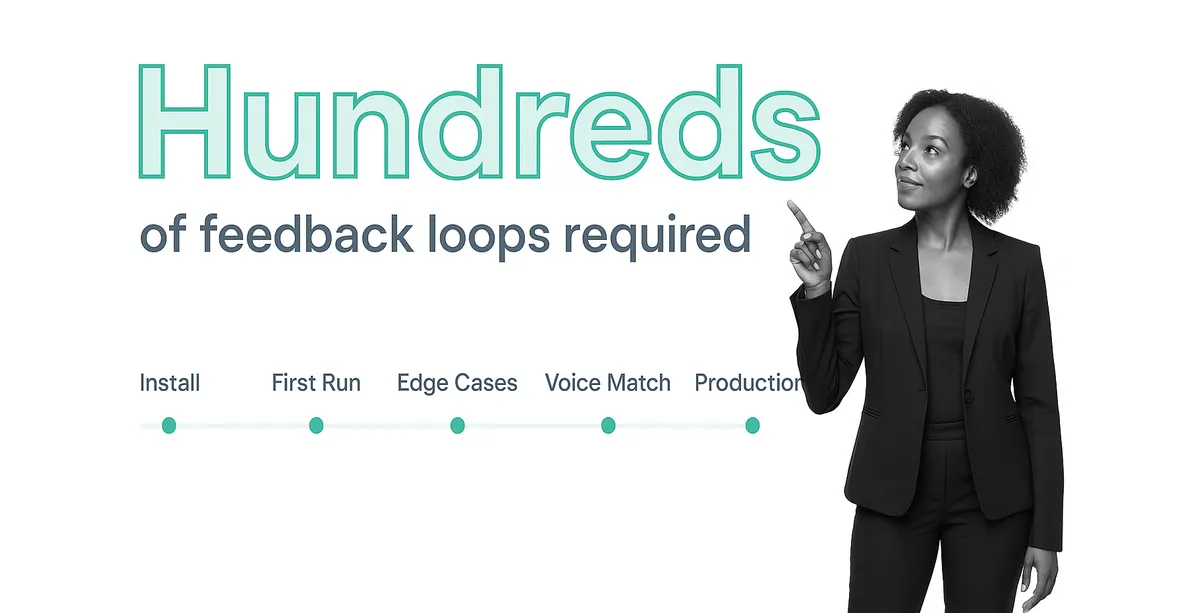
This takes hundreds of feedback loops. Not dozens. Hundreds.
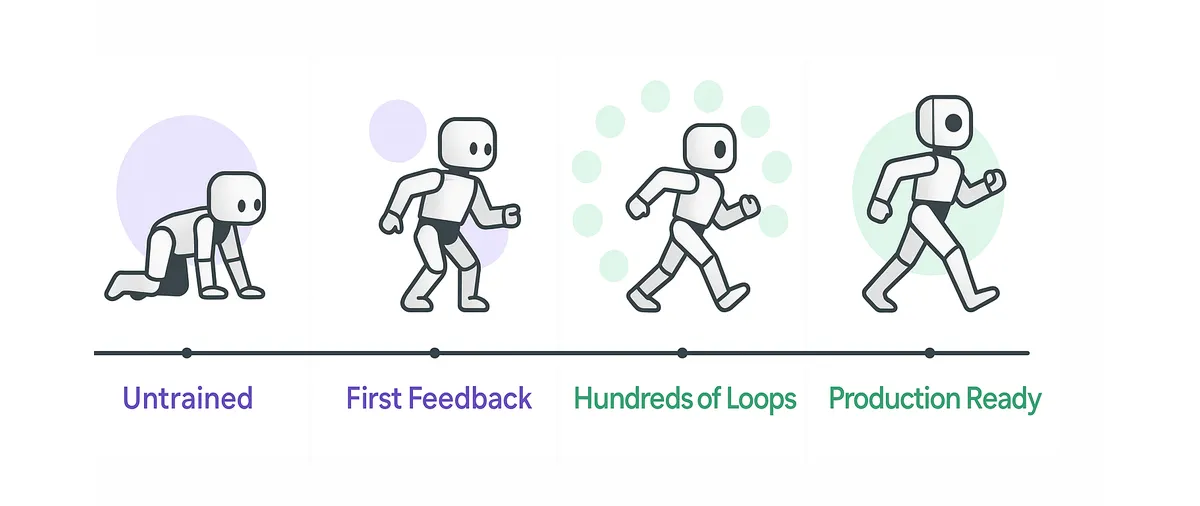
I’ve watched skills in our own system go from producing generic, forgettable output to nailing the exact tone, format, and edge-case handling we need. The difference between iteration 10 and iteration 200 is night and day. Think of it like a continuous compliance monitoring workflow: the template gets you started, but the value comes from adapting it over dozens of cycles. But most people give up at iteration 3 and conclude that “AI skills don’t work.”
Why this matters now
The AI skills ecosystem is exploding. Marketplaces, skill libraries, prompt templates, agent frameworks. The barrier to creating a skill has dropped to near zero. Every major workflow automation platform now ships some version of skills, agents, or prompt templates. You can have a working skill in under a minute.
But “working” and “production-ready” are separated by a canyon. The competitive advantage in 2026 comes from infrastructure, not intelligence. The infrastructure is the training loop. The intelligence is what comes out of it after hundreds of cycles.
Teams that understand this will build skills that compound, the same way a digital compliance officer compounds policy knowledge with every cycle. Teams that don’t will keep installing novices and wondering why AI feels underwhelming.
A skill you haven’t trained is not a skill. It’s a first draft.
The post You Don’t Have a Skill. You Have a Novice. first appeared on Process Street | Compliance Operations Platform.