











Process Orchestration: Follow One Request Across Systems
Blog: CMW Lab Blog
Process orchestration coordinates the people, applications, and automated tasks that contribute to one business outcome. It defines when each participant can act, connects the responses to the right process instance, and retains enough state to continue across delays. A useful way to understand it is to follow one request across systems and ask who knows what should happen next.
Follow a request beyond a single application
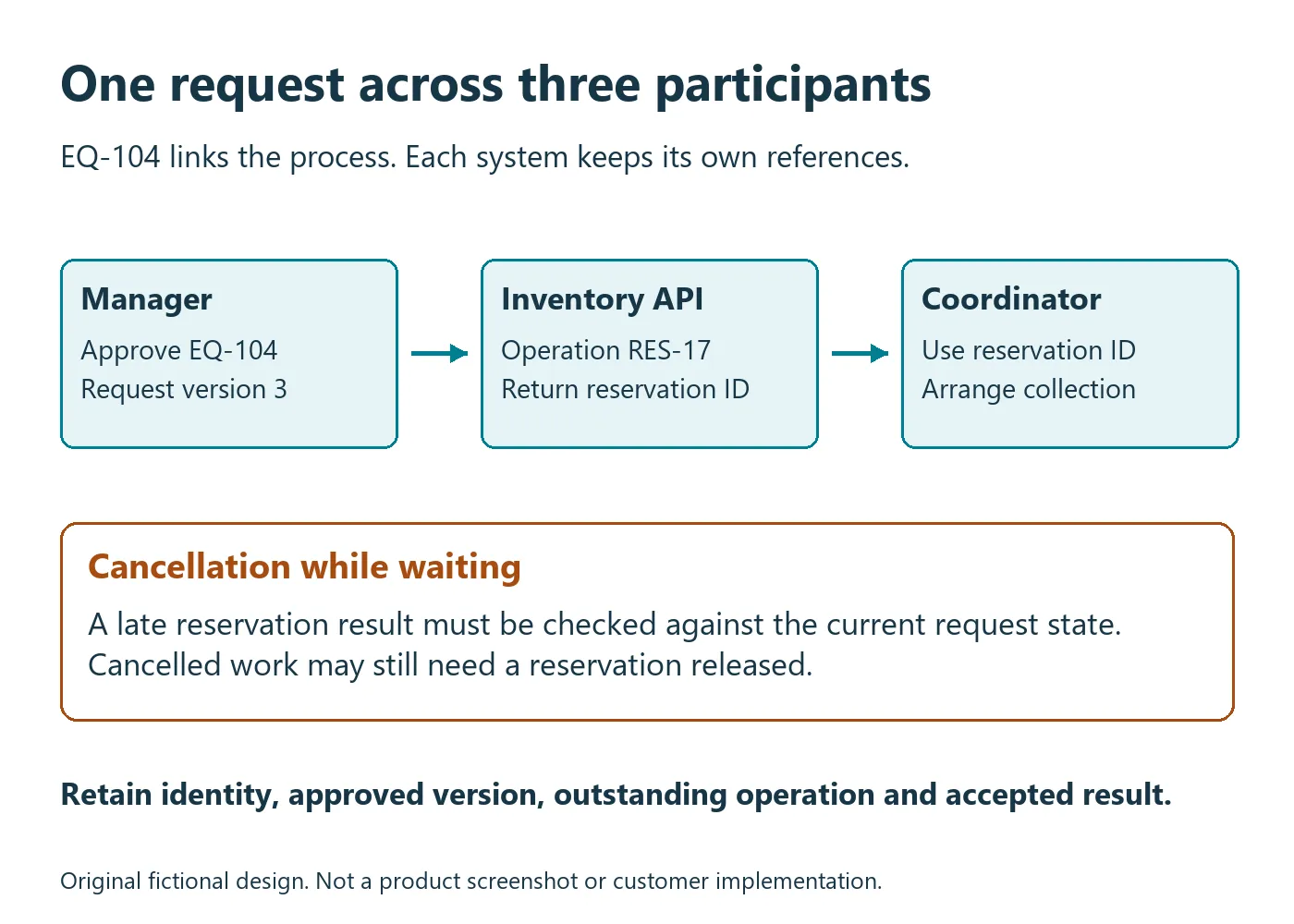
Consider a fictional equipment request, EQ-104. A manager approves a specific version of the request. An inventory application then reserves the equipment through an API. A service coordinator receives the resulting reservation reference and arranges collection. The requester can cancel before collection, subject to the organization’s policy.
Each participant can perform its own task correctly while the overall request remains unfinished. The manager may approve it, yet no reservation is made. The inventory application may reserve an item, yet the coordinator never receives the reference. Or a reservation response may arrive after someone has cancelled the request.
The orchestration design connects these local actions. It specifies the dependency between approval and reservation, the evidence required to advance, and the path for cancellation or missing responses. The goal in this example is a request whose outcome is understood across the participating systems.
Camunda’s process orchestration guide describes coordination across people and technical endpoints. Pega’s overview similarly emphasizes workflows spanning applications. These definitions describe the scope of orchestration; the equipment scenario below is an original design example.
Keep a process record that explains the next step
The request needs an identity that survives the handoffs. The inventory system can keep its own reservation ID, but its response must be associated with EQ-104 and the operation that requested the reservation. The approved request version matters too: approval of version 3 should not silently authorize the different equipment introduced in version 4.
| Boundary | Record to retain | Condition to continue |
|---|---|---|
| Manager decision | EQ-104, version 3, decision and decision-maker | The approved version is still current |
| Inventory request | EQ-104, operation RES-17, destination reference when returned | The result matches the outstanding operation and current state |
| Collection task | Reservation reference, assigned coordinator and completion evidence | The item is ready and the request remains authorized |
This is a conceptual record, not a prescribed database schema or a CMW product export. An implementation might distribute these facts across a workflow engine, application records, and integration logs. The important requirement is that the responsible team can reconstruct the decision to advance, wait, cancel, or investigate.
A process state such as “Awaiting reservation” also needs a definition. It should distinguish “not yet requested,” “request sent,” and “response received but not accepted” where those differences affect the next action. A single green status label cannot explain those distinctions.
Give waiting a deadline and an owner
Sending an API request does not establish that the business task has completed. Some services return a final result immediately; others acknowledge receipt and report completion later. Choose the interaction supported by the destination, and state which response is sufficient to advance this process.
For EQ-104, suppose inventory accepts the reservation request and will respond later. The orchestration record retains the outstanding operation. If the response arrives while the request is active, the process checks it and assigns the collection task. If the response is missing at the agreed deadline, an exception task goes to the service coordinator with the request and operation references.
The deadline should reflect the business need and the service contract. Repeatedly extending it without an owner would conceal unfinished work. A progress notification can indicate that a remote task is still active, but it is not the final business result.
As one concrete implementation reference, AWS Step Functions documents request-response, job-waiting, and callback integration patterns. Its best-practice guidance recommends explicit timeouts for waiting tasks. The supported patterns and timeout behavior must be checked in whichever engine and service a team actually uses.
Resolve a late response against the current request
Now change the sequence. The requester cancels EQ-104 after the reservation request has been sent. A success response for RES-17 arrives a minute later. If the process reacts only to the word “success,” it could create a collection task for cancelled work.
Instead, evaluate the response against the operation identity and the current process state. A reservation that succeeded remotely may need to be released, even though the original request is no longer allowed to proceed. Record both facts: the request was cancelled, and an inventory reservation still requires resolution.
Releasing that reservation is a separate business action. It can fail, require authorization, or be unavailable through the integration. In those cases, give a named role the unresolved item and the evidence needed to handle it. An orchestration layer does not automatically roll back every participating system as one transaction.
Also decide what to do if a completion message is delivered twice. The second arrival should not create another collection task merely because it repeats a valid result. The destination’s guarantees, operation identifiers, and the process’s accepted-result record determine how this is handled. Test cancellation during a wait and repeated responses before relying on the route in production.
Decide whether the process needs orchestration
A self-contained task inside one application may need only that application’s automation. Cross-system work needs closer attention when one participant must wait for another, when completion arrives later, or when cancellation affects work already started elsewhere. Those conditions make the shared process state and response rules valuable.
Workflow coordination also concerns people, information, and handoffs. This example concentrates on the execution rules that connect those handoffs across systems. A business process engine can execute process logic; orchestration describes the broader coordination responsibility. Product terminology overlaps, so inspect behavior rather than deciding by the label alone.
Before selecting software, run EQ-104 or an equivalent real scenario through four situations: normal completion, no response, cancellation while waiting, and a repeated response. For each, identify the next state, the retained evidence, and the person responsible for unresolved work. This exercise makes integration requirements much more concrete than a list of automation features.
If you are evaluating CMW’s workflow engine, use that scenario to discuss process execution and integration requirements. Confirm each destination’s supported interface and the configured exception behavior during evaluation.

About the author
Pavel Grebeshkov
Pavel Grebeshkov has more than 15 years of experience in IT projects. His background includes CMO roles at CMW Lab and Familoop, bringing a marketing perspective to the needs of business software buyers and vendors.
He is the CEO of Softosaur, a platform for the B2B software and IT community. His articles on the CMW Lab blog focus on workflows, business processes, and the practical questions teams face when evaluating business software.
The post Process Orchestration: Follow One Request Across Systems appeared first on CMW Lab Blog.