











Process Mining: Read an Event Log Before Drawing Conclusions
Blog: CMW Lab Blog
Process mining uses recorded events to reconstruct and analyze how work moves through a process. It can reveal observed routes, compare them with an expected model, and examine timing or rework. Its findings depend on what the source systems actually record: an attractive process map cannot recover events that were never captured.
Start with nine events, not a finished flowchart
Synthetic teaching data: the table describes two fictional request reviews on the same day. Times are UTC. Each row records that an activity occurred; “Review completed” is a completion event, not the time when the reviewer started working. These are invented examples for explaining the method, not CMW customer results or product exports.
| Case ID | Activity | Time, UTC |
|---|---|---|
| A | Submitted | 09:00 |
| A | Review completed | 09:05 |
| A | Closed | 09:20 |
| B | Submitted | 09:02 |
| B | Review completed | 09:32 |
| B | Returned | 09:35 |
| B | Resubmitted | 10:05 |
| B | Review completed | 10:10 |
| B | Closed | 10:20 |
The case identifier lets an analyst group events belonging to the same request. The activity label describes what happened, and the timestamp helps establish the sequence and elapsed intervals. Conventional case-based analysis often begins with these fields, but additional attributes may be needed to answer a particular question.
A current-state export containing only one row per request is different. If it says “Closed,” it does not necessarily retain the earlier return, resubmission, or review events. Before choosing a visualization, inspect whether the source preserves the history you need.
Reconstruct the two observed routes
Group the rows by case and order their events by time. Case A follows Submitted → Review completed → Closed. Case B includes a return and another review before it closes. A process discovery technique can use many such traces to derive a model of the observed behavior.
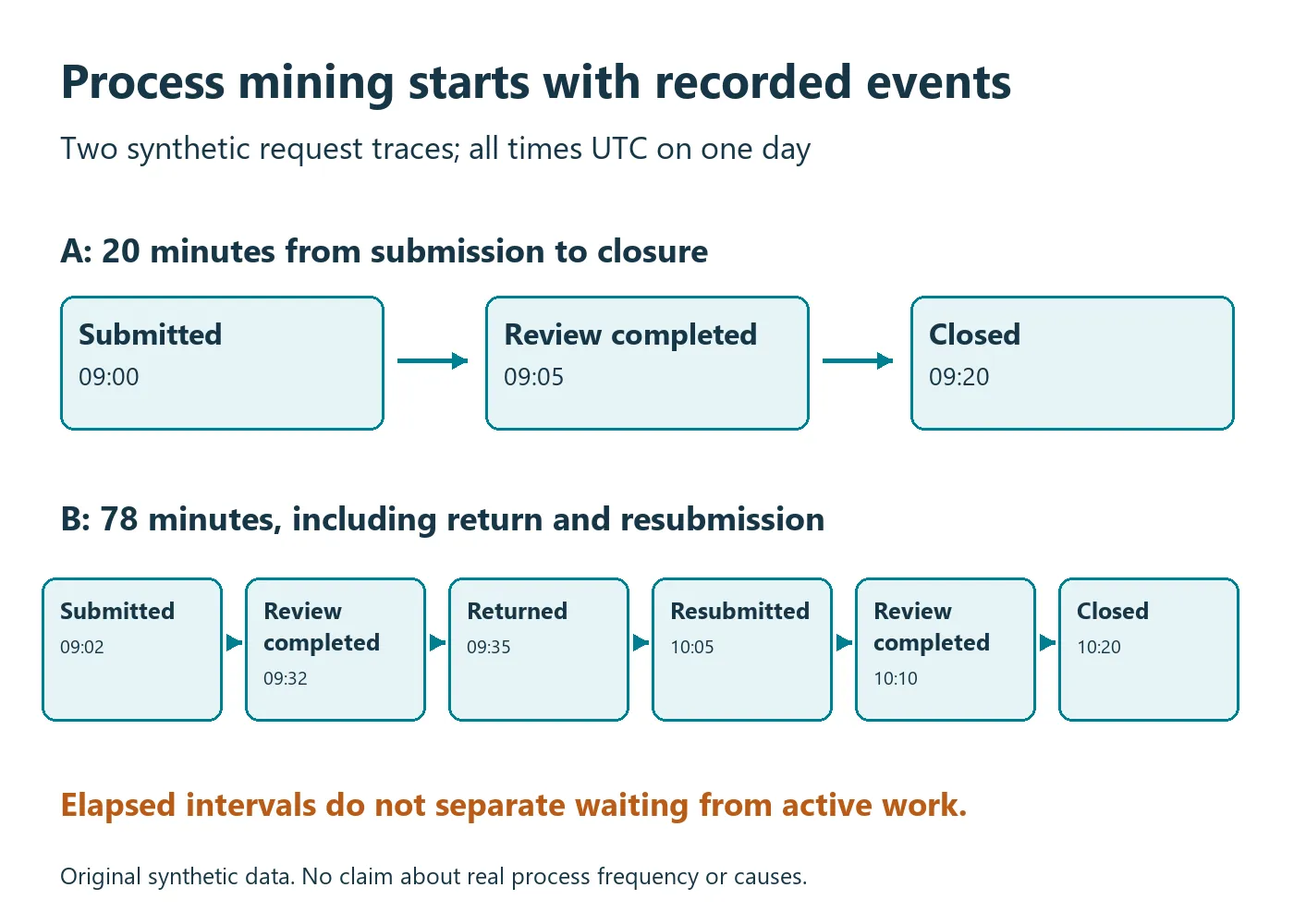
These two traces are enough to explain a variation; they are not enough to establish how often it happens across an organization. A discovered model also depends on the selected cases, activities, period, and algorithm. Filtering away rare events can make a picture easier to read while hiding an important exception.
The RWTH Aachen process mining resource distinguishes discovery, conformance checking, and performance analysis. IBM’s overview also describes discovery, conformance, and enhancement as major process mining approaches. Their common starting point is evidence about executions, rather than a diagram based only on the intended procedure.
Calculate elapsed time without inventing a cause
In this dataset, A takes 20 minutes from submission to closure. B takes 78 minutes. B also contains an observed return-and-resubmission path. Those are statements about the recorded events.
The interval from submission to the first completed review is five minutes for A and 30 minutes for B. It would be incorrect to label that entire interval “reviewer working time” or “queue time.” With only completion events, the data does not separate waiting, active work, interruptions, and other unrecorded activity.
Likewise, the return does not prove that the requester caused the delay. The brief may have been incomplete, the review criteria may have changed, or the log may omit relevant work. Use the observation to select a question for investigation, then seek the supporting records and participant context.
Compare observed behavior with an explicit expectation
Discovery asks what routes the log supports. Conformance checking compares recorded behavior with a stated model or rule. If the intended review route allows a return, B’s loop is not automatically a violation. If closure requires a recorded decision, the analyst needs the decision event or attribute before testing that requirement.
Keep the expected model separate from the observations. A discovered sequence is not, by itself, an approved policy. Conversely, a difference from a model can reflect a legitimate exception or incomplete logging, rather than a proven control failure.
Business process analysis is broader: interviews, observation, document review, and other methods can complement event evidence. Process mining contributes an execution-data perspective. Monitoring a live dashboard or drawing a workflow map does not automatically constitute process mining.
Define the data contract before expanding the analysis
Specify what a case represents and how events from different systems will be connected. A request, order, and invoice can have different identifiers and one-to-many relationships. Forcing them into one case without considering those relationships can duplicate events or distort routes. The simple two-request example deliberately avoids that complication.
Check timestamp meanings and time zones, repeated events, missing cases, renamed activities, and the difference between started and completed work. Include open cases when the question requires them; analyzing only completed cases can hide the work still waiting. Compare like periods and account for changes to the process or logging.
The RWTH resource on extracting, filtering, and cleaning event data explains why the question should guide extraction. Keep only the information needed for the analysis, and arrange access and handling under the organization’s rules. The purpose is to understand the process, not to infer individual performance from incomplete traces.
Turn the finding into a testable process change
For the synthetic review example, the next action might be to investigate why requests return and test clearer submission requirements. State the hypothesis, choose a comparable group or period, and check whether the result improves without moving work outside the recorded boundary. A faster reported interval is not enough if rejected or unfinished work disappears from the dataset.
CMW’s business process analysis and monitoring offering can be discussed as part of managing the workflow around an improvement. Verify the event data and any specialist mining tool or integration separately. This article explains a method; it does not claim that a standard CMW deployment includes a native process mining engine.

About the author
Pavel Grebeshkov
Pavel Grebeshkov has more than 15 years of experience in IT projects. His background includes CMO roles at CMW Lab and Familoop, bringing a marketing perspective to the needs of business software buyers and vendors.
He is the CEO of Softosaur, a platform for the B2B software and IT community. His articles on the CMW Lab blog focus on workflows, business processes, and the practical questions teams face when evaluating business software.
The post Process Mining: Read an Event Log Before Drawing Conclusions appeared first on CMW Lab Blog.