











OpenText OpenStudio: IT Innovation & the Global Command Center
Blog: OpenText Blogs
At OpenText World 2025 in Nashville, innovation isn't just something OpenText sells—it's how the company operates. In this OpenStudio conversation, we explore how OpenText is transforming its own IT infrastructure with AI-powered service management, building a cutting-edge Global Command Center in Waterloo, and reimagining physical workspaces to bring teams together in the hybrid work era.
Watch the full interview:
Introduction
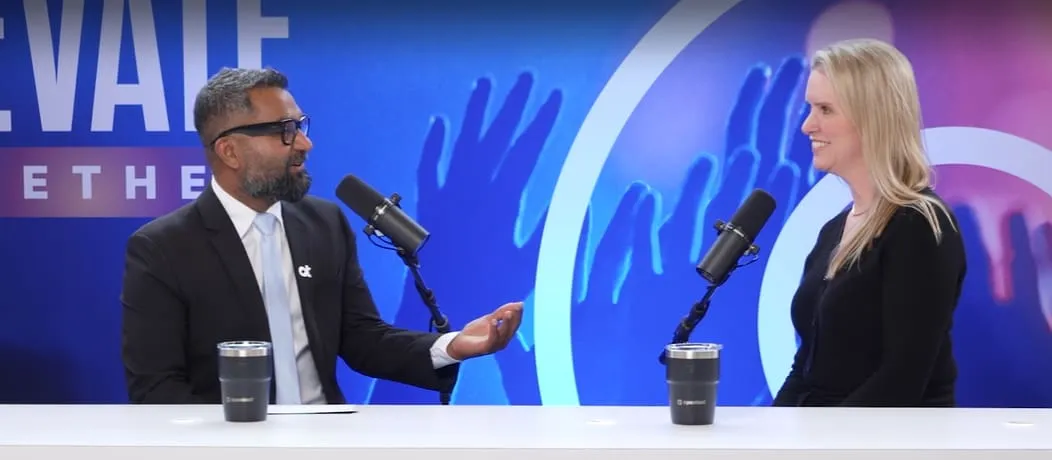
Ajit Yohannan: Hello everyone, thank you for joining again. We are having these great conversations at OpenText World as part of OpenStudio. The best part is that we're learning a lot of new things which our leaders are working on. My next guest is Lise Lefaivre, VP IT & Shared Services. We're both in the same office in Mississauga, Canada, and it's great working with Lise. Welcome to the OpenStudio, Lise.
Lise Lefaivre: Oh, thanks for having me.
The energy at OpenText World: From concept to reality
Ajit: I want to start with—you've been at OpenText World last year and this year. What's the energy? What are you seeing different this year? What are the new things happening?
Lise: It's a great question, because last year we were just starting to talk about AI. This year we're showcasing so many actual use cases, and I think that's been missing in the past 12 months. It's almost like you're in university last year, and this year we're in the workforce. I've really enjoyed watching some of those use cases come to life and showcasing them on stage, digging deeper into what our customers are using our products to help them solve in terms of AI.
Ajit: Yeah, and also I was looking at the expo. A lot of ways our teams are presenting that's great, as well. That's personally I was looking at. Do you want to talk about some of the things that you're working on currently, which is helping our customers, some of the projects that you are involved with?
Transforming IT service management with AI
Lise: Yeah, so in my role running the IT shared services or CDO shared services, I focus a lot on what our employees can use and what we can use in IT. And what that translates into is a really great use case and customer advocacy for our customers who are buying the same things that we're using. One of the things we saw today is this amazing work that's happening with our OTSM or ITSM solutions. ITSM is IT service management needs. We see them everywhere. Everybody has these service management needs. Whether or not you're trying to log a ticket for HR to ask them about your taxes, or if you're doing a legal question, or if you want a new cubicle in a facility. If you think about this, so many companies are using email to do this, and this becomes very constrictive and time consuming. Why can't everything be a simple workflow? Why can't everything be routed through a ticketing system? And when you start to do that, you get to use AI eventually. And so, I think that's something that I'm personally working on with my team and within IT is to try to take all of those service needs that maybe even people don't even think are actual workflows, get them into our OTSM solution, which can do it amazingly. And then have efficiencies and eventually we won't even need people to answer because the ticketing systems will be smart enough through our AI and through the use of agentic AI to solve for them.
Ajit: That's smart. I think the best use of technology that we create for ourselves. Everybody wants things to be easy.
Lise: The other thing that we talked a lot about today was—sure, you're going to hear us talk about the fact that we were able to reduce a help desk by 70%. That doesn't mean that 70% of our employees are no longer with us. That means that we're redirecting our skills, and we're adding a lot of value in other areas that historically may have been underfunded through human capital, and now you can fund them through this human capital because they're being diverted away from things that they don't need to do anymore.
Ajit: Absolutely, thanks for sharing.
Unveiling the global command center
Ajit: I also want to ask about the Global Command Center that we hear is coming up in Waterloo. You want to share some of that new exciting news as well?
Lise: The Global Command Center for us—and different companies use different terminology—is the combination of a security operations center and a network operations center. We're going to call it the GCC, the Global Command Center. This is super great because I've spent my career working in some form of operations. Prior to joining OpenText, that was in an airline, and there was the airline operations center. When you walk into an operations center, you're usually struck by monitors, data, dashboards, colors—you never want to see reds—people, lots of people. When it's quiet, usually things are good. When it's loud, then things are going wrong. What we're creating in Waterloo, our headquarters, is the next level. I don't even want to call it generation, it's almost re-envisioning what these operating centers can look like. We're super proud of what we're pulling together. Everything from the tooling, which is OpenText tooling and observability tools, to how we run our network operation, to how beautiful the facility itself is going to look, to the celebration of the history of OpenText that's going to guide you into the operations or the GCC. There is a lot going into what this GCC will be for OpenText, and it's going to be one of those things that we're so proud of, because it's going to be beautiful, but it's going to be practical, and it's going to be powered by all of our own tools.
Innovating physical infrastructure for employees
Ajit: That's awesome. I know you also have—while the digital infrastructure for employees—you're also in charge of the physical infrastructure. What are you doing that's innovative? What's been your response? How are you helping our employees with that?
Lise: What a great question. Recently taking on global facilities across the world, I often joke that there's one thing that unites everybody around the world, and that is they have something in common related to how they perceive and work with their physical space. We see so many companies coming back to the office post the pandemic. It's been hard for some people to return to the office, but here at OpenText, we do believe that we are better together. That "better together" has to be underpinned by these beautiful facilities that are practical, provide health and safety benefits, and bring together our amazing talent. What we're trying to do in the facilities world is not only provide all of that, but also look at opportunities to use AI through visitor booking systems, through the way in which we plan where our people sit. There's so many ways that we can continue to use technology, even in something like facilities management, to again help alleviate those redundant tasks and get those people creating amazing experiences within the facility—maybe not so much behind a keyboard.
Ajit: Absolutely, we're always better together and thank you for creating that environment.
Connecting internal innovation to customer success
Ajit: I also want to see, ask you about how are some of these, you spoke about leveraging our IT infrastructure, all of that, how you're going to help this to our customers' advantage? Are you also connecting it back whatever we have to our advantage so that some of our customers can take as well?
Lise: So right before I started with you, Ajit, I had to leave because I'm at a conference and I saw a customer walking by who I know was interested in some of the solutions that we're using. And so while I might be an ambassador to OpenText and work at OpenText, at the end of the day, I work in IT and I run tools to solve my business problems. And so wherever I can work closely with our product team to solve my business problem, which is usually generic in general, I get the chance to go and run and tell a customer, guess what we just solved for? Are you trying to solve for the same thing? I promise you that I've been advocating on all of our behalf and look at what our product does. And so that's kind of my really cool role in working at a software company and being able to use the products, is that I'm a really good reference point for what it can do. And you know what, I'm pretty honest about what it can't do. And you know that's why people will always end up with a high level of satisfaction when they use our tools because it was very clear from an actual user what it is I'm able to achieve and what are the things that I'm not quite there yet.
Ajit: That's awesome. Yeah, I think what else we can help, however, we can help our customers. I'm glad you're doing that.
Vision for 2030: The future of OpenText World
Ajit: So here's my fun question. Imagine this is 2030 and this is a very different place. Obviously we are hosting the OpenText world. What's your prediction? What's going to be like? Are you going to see a lot of bots moving around? What innovations?
Lise: Well, I'm picturing you as a robot right now, and I think you're gonna have really human characteristics and you're gonna sense my sentiment. No, I do not. I do not think that in 2030, we're going to be sitting at a conference that is being replaced by humans. I think that in 5 years from now, our humans are going to be having incredibly intellectual conversations, and we're going to be talking about deep insights, and we're going to be debating points of view on how to progress healthcare, aviation, supply chain. And we won't be talking about, we will be talking about, remember the day when we used to have to sit in front of an email and answer a question related to taxes on my, on my paycheck. So I, I foresee a world that is still full of humans, and these humans are just having amazing, deep, insightful conversations.
Ajit: Thank you so much. That, that's really interesting because yeah, we are not going to be replaced by bots. That's maybe you, not me. We'll see that in 2030.
Leadership philosophy: Energy, positivity, and clear priorities
Ajit: But thank you so much for speaking. Yeah, but I also want to know about your leadership. I know you're leading a large team of IT professionals. How do you keep them motivated? How do you give them the interesting ways in which they can innovate? What what's been your style?
Lise: Yeah, well, my style is a high energy style. I like to come in, positive attitude, always see the good in anything. Sometimes there are factors around us that impact the way in which we work. The pandemic was a big one. None of us could control it, but we could, could control the way in which we showed up every day. And so my leadership style has always been, be positive, bring energy, put a smile on your face, and then for the team, just be really clear on the priorities. Don't let your team work on things that are not high priority. Be really close to your team, be accessible, break down the barriers. For me, these things seem somewhat easy, but I don't think for all leaders it is. You know, leadership is not always easy when you're asked to do things that perhaps you're not 100% behind. Find those things that drive energy and, you know, be positive every day because we're pretty lucky to be here.
Closing
Ajit: Thank you so much. I can't agree more with you on being the high energy that Lise is. Anytime you're either in Waterloo or in the Mississauga office, please drop by and say hi to her. She won't disappoint you. Thank you so much, Lise. Thank you so much for speaking and it's always a pleasure connecting with you. Thank you all for joining and see you soon.
About OpenStudio
OpenStudio is OpenText’s media hub for thought leadership and innovation. This series explores stories of progress and success from industry experts, visionaries, and trailblazers. Our goal is to inspire, inform, and connect audiences with the people and ideas shaping the future of the digital world.
The post OpenText OpenStudio: IT Innovation & the Global Command Center appeared first on OpenText Blogs.