











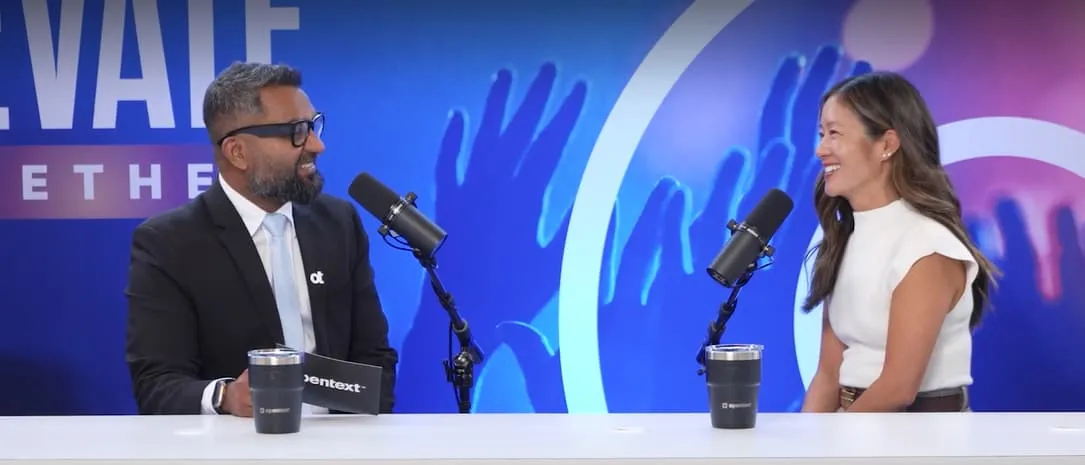
OpenText OpenStudio: Context over volume in enterprise AI
Blog: OpenText Blogs

As enterprises race to implement AI, a critical question emerges: why do some organizations see transformative results while others struggle? At OpenText World 2025 in Nashville, the answer becomes clear—decades of disciplined content management, security, and governance create the foundation for AI success. This OpenStudio conversation explores how OpenText's approach to contextual AI differs from competitors, why "garbage in, gospel out" represents a dangerous misconception, and how modernization and AI enablement work hand in hand.
Watch the full interview:
Introduction
Ajit: Hello everyone. Welcome to Nashville. My name is Ajit Yohannan. Welcome to OpenText World 2025. It's been a great event so far. We're meeting great customers and leaders, great conversations, and I'm glad this year too we have the OpenStudio, and we're going to have a lot of great conversations and my first guest is not new to OpenText. She has been with OpenText for more than 10 years.
Lindsay: Almost 10 years. Almost 10 years.
Ajit: Lindsay Sterrett, Vice President of Product Marketing across our Content, Experience, Analytics, and Legal Tech business units. Welcome to OpenStudio!
Lindsay: Thank you for having me. It's great to be back.
Ajit: Yeah, good to see you. And let's get started. How's the OpenText world 2025 for you so far?
Lindsay: It's been crazy busy, but in the best way possible, just constantly getting a chance to interact with customers, partners, colleagues that I haven't seen in a year. It's been truly amazing, like the energy, you feel it everywhere.
Ajit: Absolutely the Music City, it's called Music City.
Lindsay: Yeah, it's great.
Top takeaways from OpenText World 2025
Ajit: Yeah, I just want to also check what's been your top takeaways from this year's OpenText.
Lindsay: So, our keynote was yesterday, and the top takeaway for me is that OpenText customers are primed to get the best outcomes from AI because they've made this long-term investment with OpenText, with their content or document management, right? That we've been, one of our key messages this week has been that, you know, AI is everywhere, of course, there's no escaping AI. But it's, there's a difference with not all AI tools are created equal, let's put it that way, right? And because our customers have spent in some cases 10, 20, 30 years investing with OpenText on their document management strategy, getting it organized, adding context, and integrating it, governing it, securing it, that is again, setting them up for the most superior AI outcomes.
Ajit: That's awesome. Yeah, I think I'm sure you're talking to a lot of customers. What's the feeling you're getting after talking to all these customers? Are they looking at the new OpenText with a lot of excitement?
Lindsay: I think so. I think so. I think that our customers are really excited about where we're headed for an AI and data company. I think that really resonates with our customers and in a lot of ways, it's again, getting back to the core foundation of how that information is managed.
Content Cloud: 5 takeaways from OpenText World 2025 >
AI and security in the content space
Ajit: Nice. And you've been also in product marketing, so AI alongside the security. So how do you see that shaping up? Are you getting a lot of feedback from what we already have and what's the new things coming up?
Lindsay: Yeah, so I think in the content space security has been, you know, embedded in everything that we do. And again, that is, you know, as part of an organization's AI strategy, it's about ensuring that the AI is being used in the most appropriate ways, that it's being used by the right people, that the AI and the people are accessing the right information at the right time. And I think from an innovation perspective, what we were talking about in terms of AI agents, right, that being the new cool thing, that there's a lot of opportunity for that to now be, you know, how different systems is everybody's got multiple applications, right, even as we were working in probably dozens of applications every day. The agents can now potentially be a way for all those different systems that we're working in to work more seamlessly together, right?
How OpenText differentiates from the competition
Ajit: Yeah. I also want to know how are we different from the competition. There's a lot of competitors and there's a lot of AI noise. How are we differentiating ourselves?
Lindsay: So, great question. There's a bunch of different ways I can take that, but maybe to start. You know, one of the things that I think is really going to set OpenText apart is that we're letting, we're giving customers the technology to let AI do its work against the most appropriate data or content, right? So, I think there's, I forget who I was talking to this morning, but they said, you know, garbage in gospel out. Some people have this tendency to believe that the more data and information that you throw at your AI, the better it's going to work. It's actually quite the opposite, from our point of view, and this is again where OpenText and our approach is differentiated, is that our technology is so sophisticated in understanding the context that it's about putting the AI in a, you know, it's very specific to the information needed for a specific task or a specific workflow or process, right? So it's not about just throwing everything in at it and seeing what comes out and believing that that's the gospel, right? But actually being able to pinpoint it down to, again, the most, the best and most contextual information for whatever the job is that needs to be done.
Ajit: Yeah, that's, I like the way you put it, garbage in, gospel out. That's not, it's usually garbage in, garbage out, right? So that one was a fun one I wanted to borrow.
Priorities for FY 26
Ajit: No, I think that's good. And in terms of the priorities for your FY 26, has it changed or you want to reiterate, what are you going to focus on?
Lindsay: So, you know, for me, I think our mission is crystal clear, right? We, and it hasn't really changed. We're trying to give our customers a path to modernize. We announced some new migration tools coming in 26.2 that are gonna make it easier and faster for our customers to get to the latest version, to get to the cloud, and AI is a big driver behind that, right? So another big announcement that we made is that Content Aviator is going to be free for any customers that upgrade to the 26.1 version coming in January or next year at the start of the year. And that's huge, right? So we're unlocking AI and making it available for all of our customers. And again, it's those two things, I think go hand in hand, right? It's modernization and that being an enabler of AI for our customers.
Ajit: And then I assume these conversations are helping you shape the future opportunities with our customers here at OpenText World as well.
Lindsay: Yep, absolutely.
Using OpenText products internally
Ajit: And are you also using OpenText product to showcase to our customers that how we are, we as a company is also using our OpenText product and getting that value out of it. You want to talk about that?
Lindsay: That's a great question. So we actually have a fantastic example of that. Our global sales organization is actually using Content Aviator on top of OpenText Content Management for enabling all sorts of sales use cases powered by AI, right? So, you know, being able to create a workspace that has all sorts of different materials related to a customer that they might have in their pipeline, right? Tracks, RFPs, maybe even external information about that customer and using that to then, you know, with Content Aviator refine how they might respond to that RFP, right? You know, bringing in product documentation or previous RFP responses, tailoring objection handling or some of these really common sales scenarios that all of our account executives are dealing with on a day to day basis, but doing that at scale. Right, I think that's a super cool example of us drinking our own champagne, so to speak.
Ajit: That's awesome. I saw a great set of demos happening within the expo, and I want to ask this question. Imagine this is 2030 and what kind of innovations that you would be seeing on the shop floor.
Lindsay: What year is it? We're 4 years out, right? That's a tough one.
Looking ahead to 2030
Lindsay: Again, I think it's going to be, yeah, you know, I think it's going to be about those digital knowledge workers, right? Our teams, our customers being able to leverage our AI to do work to automate a lot of these tasks that can be done at scale and don't need the human touch. And then that frees you and me up to do things that are more valuable use of our time. That's probably coming sooner than 4 years. This is actually, that's a tough, it's a tough question, but I would also hope that by 2030 that we're, you know, all of our customers are on the latest version that they're AI enabled, right? You know, SaaS is another thing that we've been talking about a lot this week with OpenText Core Content Management, right? So I think, you know, it's all about getting to the cloud and getting AI enabled in whatever form that looks like in 4 years.
Final thoughts
Ajit: That's awesome, and any final thoughts to our listeners on from the floor and what's been working? Your final thoughts?
Lindsay: Yeah, you know, I just think that it's a great opportunity to be here and to learn, connect, I think it's been. And one of the biggest things for me is just having the opportunity to be in person with so many of our customers and colleagues, our partners. It's like the most invaluable experience, right? So we're learning and we're going to breakouts and keynotes and seeing the demos and things like that, but probably the most important intangible value is just that person connect, that personal connection. So it's been awesome.
Ajit: Yeah, that's not going to be replaced by, that can't be replaced by AI. And this podcast as well. Thank you so much for speaking and great always talking to you. So thank you all for tuning in and we'll see you again.
Lindsay: Thank you. Thank you.
Learn more about the OpenText Content Cloud
About OpenStudio
OpenStudio is OpenText’s media hub for thought leadership and innovation. This series explores stories of progress and success from industry experts, visionaries, and trailblazers. Our goal is to inspire, inform, and connect audiences with the people and ideas shaping the future of the digital world.
The post OpenText OpenStudio: Context over volume in enterprise AI appeared first on OpenText Blogs.