











Business Writing Tips: How to Write Processes for Human Beings
Blog: Blog | Process Street | Compliance Operations Platform
Clear business writing helps people understand what to do, who owns the work, and what a finished result looks like. That matters in every email and memo, but it matters most in process documentation, where one vague sentence can create a missed step.
Writing is a skill of minimalism. Draft the full idea, cut the clutter, choose concrete words, then test the instructions with the person who will use them. AI can accelerate a first draft, but the writer still owns the meaning, accuracy, and final edit.
These business writing tips focus on clear, useful prose for complex operations, content marketing, and any situation where human beings need to understand and act.
Clarity above all
There came a point near the end of my school years where we got the freedom to do whatever we wanted during class time, as long as it was relevant to the lesson. It was there I read an essay, in English language class, that has made a huge impact on the way I think and write. A concise, powerful essay by George Orwell from 1946 called Politics and the English Language.
Spoiler: it reads “stop talking so much rubbish, you idiot”.
While Orwell angrily wrote it about the way politicians speak, it applies today to all writers and speakers. When I saw How to Write and Document a Process that Actually Gets Used by Wade Foster – CEO of Zapier, I felt a familiar feeling and went back to read the Orwell essay for the first time in years.
I thought “George Orwell would have some killer business writing tips.”
Politics and the English Language is a short essay, in keeping with a basic rule of writing: quality over quantity. In Orwell’s words, “If it is possible to cut a word out, always cut it out”. In my words, “Cut words if you can” (take that, George).
For Orwell, clarity is the core of writing well. According to his way of thinking, bad writers are pretentious, arrogant and more concerned with sounding intelligent than writing for others to understand. To understand how to write clear process documents, first understand how to write clearly. A business process documentation template can give the work structure, but the sentences still need to tell a human exactly what matters.
Clutter-free business writing tips
Mostly we want to discuss the issue of clutter. Imagine you have just opened a checklist and need to complete the work without decoding every sentence. Which of these would you rather read as the first point?
1) “Create custom credentials (username and password in accordance with prerequisite complexity protocol) and ensure execution of the correct implementation of the internal Company email system for new personnel” 2) “Sign new employees up for company email”
If you’re still with me after that horrible string of words, I consider myself lucky.
Do not rely on luck. Make your business process documents clear enough to use on the first pass. These business writing tips will make your life easier as well as the lives of anyone reading what you write. In the humble opinion of George Orwell, if you can’t avoid these four things he will hate your writing and not read your process.
Cliches and metaphors
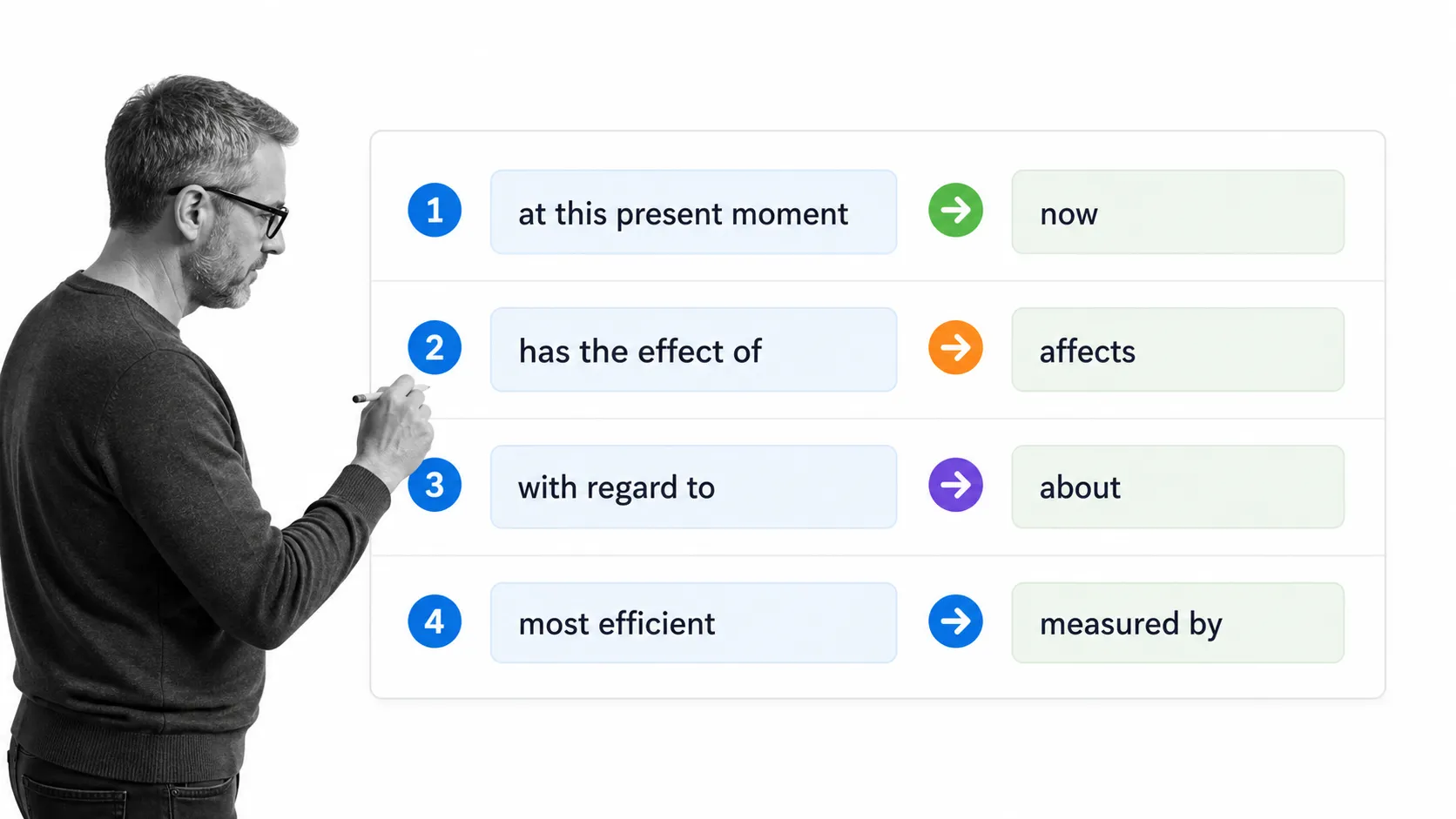
Why say ‘at this present moment’ when you could say ‘now’? I break this rule daily, but writing lean content is slowly teaching me not to, even though I’m scarred from past work in the dark days (when I had to write countless 1,000 word articles a day about various bathroom-related services so I could pay bills). I was encouraged to clutter my horrendously keyword-stuffed articles with extra words just to fill space. When writing valuable content (read: content unrelated to ‘bathroom installation professionals London’), the rules change.
Examples: take one for the team, there’s a fine line, all dressed up with nowhere to go, smell something fishy.
Bloated verb phrases
Do not write in legalese. Wordy, complicated structures make ordinary instructions harder to understand. For most business writing, use the words you would use to explain the task to a capable colleague. Bloated verb phrases, as I’m going to call them (Orwell called them ‘operators or verbal false limbs’, erm?), occur when verbs are complexly connected with conjunctions. To clear this up a bit, compare these two examples.
1) This system has been installed for the effect of the provision of notifications to the manager. 2) This system notifies the manager.
The amount of words I could cut from the first example makes me nervous (update: I can’t believe it’s still there so far into the drafting process). See how much better #2 is? So will everyone else. Unless a legal requirement demands different wording, write like you would speak to a capable colleague. During the edit, look for verbs hidden inside nouns, unclear owners, stacked prepositional phrases, and passive constructions that hide who must act.
Examples: has the effect of (affects), with reference to (referencing), bearing a likeness to (similar), with regard to (about).
Pretentious words
Prefer the word your audience will understand immediately. Get may work better than acquire, and think may work better than ponder, but precision matters more than a word’s origin. Your reader will decide whether you have authority. Intelligent-sounding words cannot create it for you.
Examples: expedite, ameliorate, extraneous, subterranean, clandestine.
Meaningless words
Words with private meanings have no meaning at all. Be careful of statements that are trying to sound impressive through comparisons to unmentioned things, such as “the most efficient project management system”. What is the writer’s private meaning for efficient here? A project management system’s efficiency could be measured by user experience, server load time, or any number of factors; this statement means nothing without more details.
Remember you’re trying to convey meaning, don’t assume the reader knows what you’re talking about. Glen Long from BoostBlogTraffic puts it well in this article, writing “Your writing is the instruction manual for assembling ideas in your reader’s mind.”.
Meaning through words comes with concrete terms, not debatable, abstract ones.

(I’m not using concrete and abstract in the technical sense here, just as concepts.)
On Writing Well
Enough about Orwell and a quick look at a slightly more modern text. William Zinsser’s 1976 book On Writing Well, (revised in 2006 after 30 further years of research) believes clarity comes from getting rid of clutter.
“Clutter is the disease of American writing. We are a society strangling in unnecessary words, circular constructions, pompous frills and meaningless jargon… It won’t do to say that the reader is too dumb or too lazy to keep pace with the train of thought. If the reader is lost, it’s usually because the writer hasn’t been careful enough.”
A tome of near-Biblical proportions for content writers, On Writing Well comes with a hand-written draft for the reader to see how much can be cut out (even, in this case, after five full rewrites).
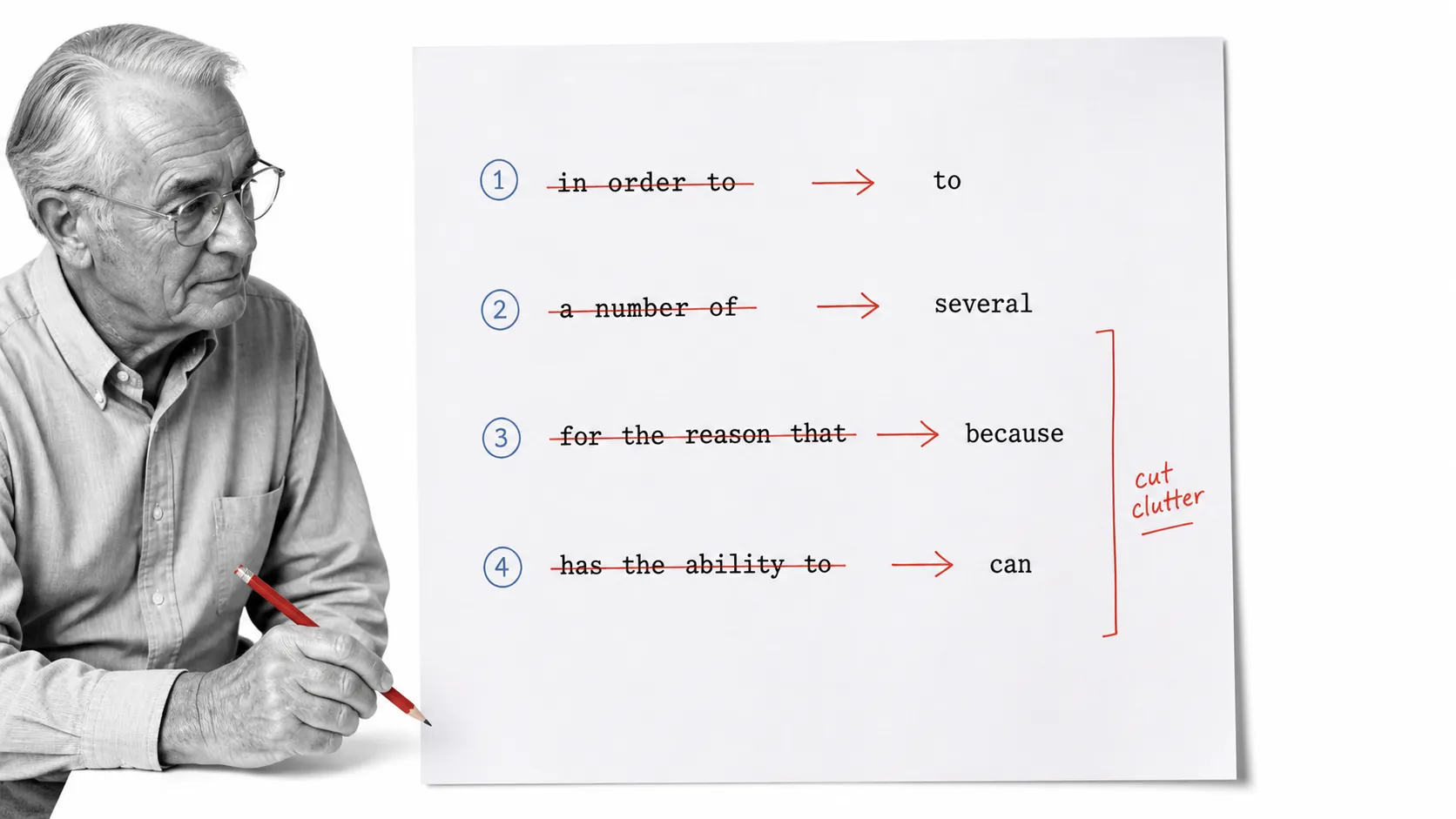
In the age of business jargon and management buzzwords, see Zinsser’s stance on it all:
Don’t dialogue with someone you can talk to. Don’t interface with anybody.
I’ll add a few of my own. Don’t fire off an email when you can just send it; don’t help out when you can help, and don’t do something for the reason of when you could do it because of.
Refined through experience
Shooting forward in time again to familiar ground for me, Atul Gawande’s The Checklist Manifesto. In this book the author meets with checklist experts to study their methods and learn how to write the perfect checklist. Gawande visits a Boeing facility and interviews Daniel Boorman, a production test pilot in charge of writing flight checklists since 2001. As you might expect, he knows a thing or two about writing user-friendly processes.
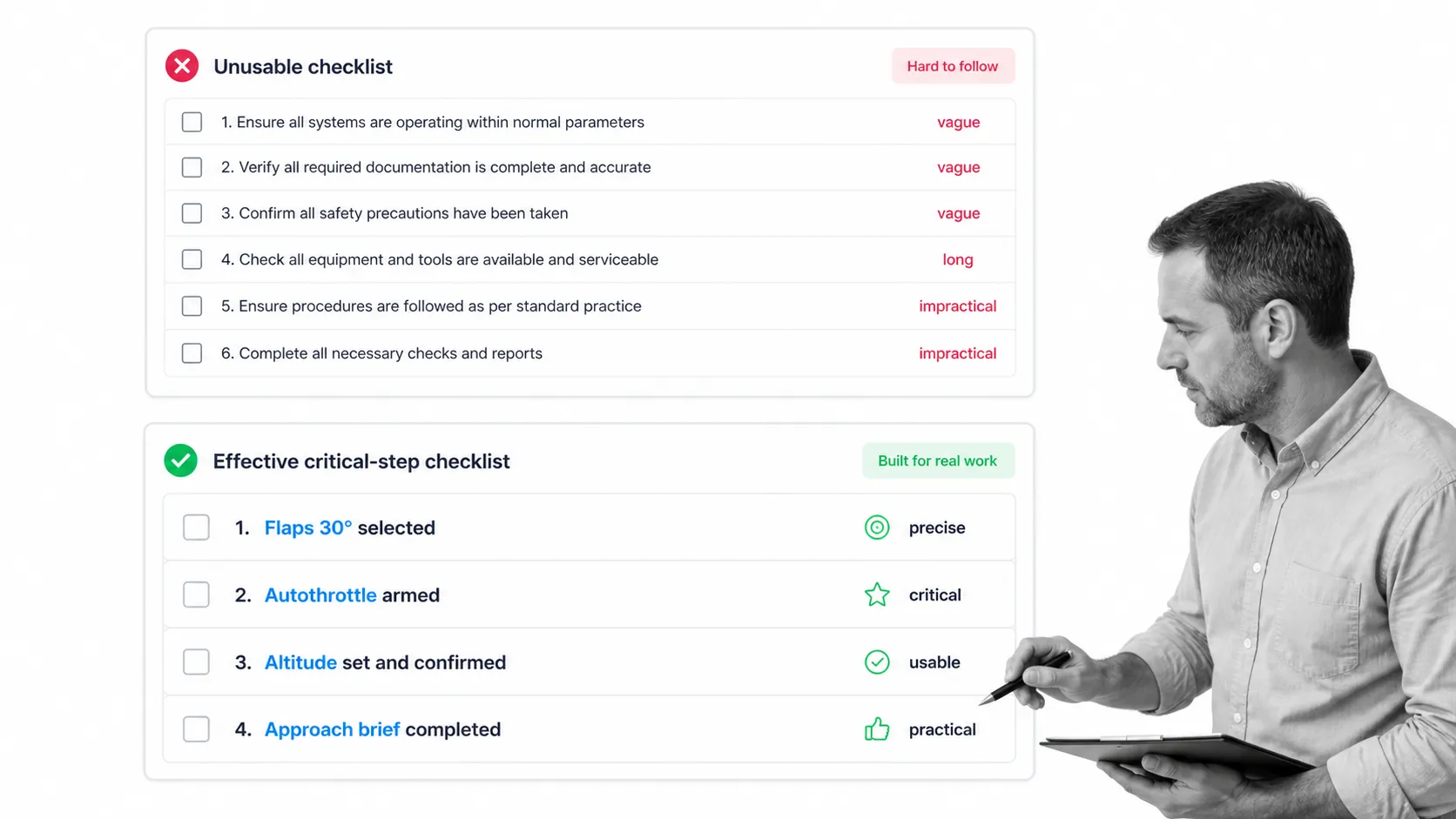
Boorman characterizes bad checklists (and breaks Orwell’s rules):
“There are good checklists and bad… bad checklists are vague and imprecise. They are too long; they are hard to use, and they are impractical. They are made by desk jockeys with no awareness of the situations in which they are to be deployed. They treat the people using the tools as dumb and try to spell out every single step. They turn people’s brains off rather than turn them on.”
And good ones:
“Good checklists, on the other hand, are precise. They are efficient, to the point and easy to use even in the most difficult situations. They do not try to spell out everything. , a checklist cannot fly a plane. Instead they provide reminders of only the most critical and important steps , the ones that even the highly skilled professionals could miss. Good checklists are, above all, practical.”
Process Street is one Compliance Operations Platform with Docs and Ops capability areas plus built-in AI. Teams govern policies and procedures in Docs, turn them into auditable workflows in Ops, and use AI to draft, enforce, and improve the work. The same editing principle applies inside the platform: processes stay useful when the people doing the work test them and keep them current.
A quick reference guide to Boorman’s criteria – do Boorman’s words remind you of Orwell’s, by any chance? Here are the key points.
For more information, see my Checklist Manifesto Review and Vinay’s summary over at Abstract Living.
The balance between comprehensive and simple
Finding the near-mythical twilight zone between comprehensive and simple is a problem any creator (writer, programmer, graphic designer) will face. Starting from the ground up is the only way to do it. Even Boorman, Orwell, Zinsser and Gawande couldn’t write great business process documents without editing or drafting. Remember that excerpt from On Writing Well? That was an edited 5th draft and it was still more cluttered than the version that eventually went to print.
You’re not going to get it right immediately but you are going to draft, test and rewrite – probably for a long time.
In the end you’ll find something that works for you, your team and even people unfamiliar with what your business does.
The final test is practical: can a person unfamiliar with the process read the instruction once and take the right action? If not, cut another word, name the owner, add the missing context, and test it again. When the process is worth standardizing, decide what belongs in the workflow, then use Process Street to govern the documentation and run the work with evidence attached.
Good business writing is finished when the reader can act without guessing.
The post Business Writing Tips: How to Write Processes for Human Beings first appeared on Process Street | Compliance Operations Platform.