











8 ITIL Processes for First-Class IT Service Management
Blog: Blog | Process Street | Compliance Operations Platform
Strong IT service management runs on repeatable processes, not heroics. This guide gives you eight free ITIL process templates you can run in Process Street right away, covering everything from incident, problem, and change management through to continual service improvement, so your team handles IT work the same reliable way every time.
ITIL, the Information Technology Infrastructure Library, is the most widely used framework for IT service management. It organizes the practices that keep IT services aligned with the needs of the business, from logging an incident to reviewing a change after it ships, and it is the backbone of first-class IT service management in most enterprises and government agencies.
Traditionally, ITIL groups those practices into a five-stage service lifecycle: service strategy, service design, service transition, service operation, and continual service improvement. We break that lifecycle down in detail in a separate guide to the ITIL service lifecycle, which is well worth reading if you want to understand how each stage connects.
A quick note on versions: ITIL 4, released in 2019, reorganized the framework around a Service Value System and now describes 34 flexible “practices” rather than the older five-stage lifecycle. The eight processes below remain core to modern IT service management and map cleanly onto their ITIL 4 practice equivalents (change management, for example, is now called change enablement). We have kept the familiar lifecycle structure here because it is still the clearest way to organize the work.
Incident management, change management, and problem management have long been the most widely adopted ITIL processes. An early cross-national study of ITIL adoption found incident management in use at 95% of the organizations that had embraced ITIL, change management at 88%, and problem management at 71%. Whether you are already running ITIL or just getting started, the templates below give each process a clear, repeatable structure you can put to work today.
If you want to dive straight in, use the quick links below. Otherwise, scroll down for a short intro to each process and other useful resources.
- ITIL Incident Management Process Template
- ITIL Problem Management Process Template
- ITIL Change Management Process Template
- ITIL Request for Change (RFC) Template
- ITIL Release Planning Template
- ITIL Post Implementation Review (PIR) Template
- ITIL Access Management Process Template
- ITIL Continual Service Improvement (CSI) Template
Our 8 ITIL processes for streamlining IT service management
ITIL process #1: ITIL Incident Management Process Template
Simply put, the goal of the incident management process is to restore normal service operation as quickly as possible when an IT-related issue has caused disruption.
The process plays a vital role in the day-to-day operations of organizations, regardless of size.
If you do not already have a formal incident management process in place, adopting this checklist could transform how efficiently you resolve IT incidents and, in turn, have significant benefits on productivity.
“The best incident management teams rely on a clear process with defined steps to work through each incident. The approach may vary slightly between organizations, teams, and how rigidly you follow the ITIL framework, but most follow the same basic path to resolution.” – Lucidchart, How to Implement a Succesful ITIL Incident Management Process
The main benefits of establishing a clear, effective incident management process are:
- Decreasing business and user downtime
- Reduce IT service costs
- Identify service improvement opportunities
- Improve user satisfaction
- Demonstrate the value of high-quality IT management
Even if you have a formal process in place, this checklist can be integrated with your ITIL framework to gain greater visibility into each ticket, streamline collaboration, and simplify the tasks that require approval with our new approvals feature (more on this later in the post).
Click here to get the ITIL Incident Management Process Template!
ITIL process #2: ITIL Problem Management Process Template
ITIL problem management is often confused with incident management. Although they do overlap to some degree, there is a clear difference that can be understood very easily.
They have different goals.
Problem management focuses on preventing or minimizing the impact of one or more incidents by finding the root cause. In other words, every incident is caused by a certain problem. Perhaps several incidents are caused by the same problem. Solving a problem is a long-term solution that in turn resolves related incidents.
This checklist is intended to be paired with the Incident Management Process Template to establish a comprehensive problem management process flow that will minimize service disruptions and business downtime.
Following these processes will ultimately support business agility, demonstrate IT-business strategy alignment, and enable the organization to compete on a high level.
Click here to get the ITIL Problem Management Process Template!
ITIL process #3: ITIL Change Management Process Template
Change management is another absolutely essential ITIL process that is part of the Service Transition stage.
The goal of change management is to establish standard procedures for managing change requests in an agile and efficient manner. If you are still deciding what system to run it in, it is worth comparing your options in our roundup of change management tools.
The process is closely linked to incident and problem management in that a change may well be required to resolve certain incidents.
“Incidents are directly linked to a change when there is a need to roll out new implementations. For example, The IT team identifies that the recurring WiFi issues are due to a faulty router. In this case, the team replaces the old router with a new one through ITIL Change management process.” – Freshworks (Freshservice), ITIL Change Management Process
Even so, changes can be unrelated to problems or incidents and be requested in order to proactively improve service operations.
This checklist will enable you to execute the change management process with great efficiency. It takes you through the process of receiving and approving a Request for Change (RFC) form (template below), all the way to implementing the change and conducting a post-implementation review (we have created a separate template for that, too!).
Click here to get the ITIL Change Management Process Template!
ITIL process #4: ITIL Request for Change (RFC) Template
As I mentioned in the description of the change management process template, each IT change requires a formal RFC to explain various important details regarding the change that is being proposed.
For example, each change is backed by a change owner, who holds a budget for its implementation. It is the responsibility of this individual to make sure the change proposal has been evaluated properly in order to make the correct decision to either implement or reject the request.
The RFC contains information such as the change priority, description of the change, reason for its implementation, a risk analysis, time schedule, and estimation of resource requirements.
To ensure that all of this information is being provided properly, a formal process is extremely useful and can make a significant difference in how efficiently important changes are approved and implemented.
This checklist guides you through the entire process, ensuring all information is provided so that change management can review and approve change requests without unnecessary delays.
Click here to get the ITIL Request for Change Template!
ITIL process #5: ITIL Release Planning Template
Release planning is the first fundamental process within release and deployment management (known as release management in ITIL 4), which is then followed by scheduling, building, testing, and deployment.
Without a well-executed planning process, the whole release is at risk of falling apart later on in the process, resulting in a waste of time, money, and resources.
The release plan aims to address the following topics:
- The changes that will be included in the release
- The parties who will be affected by the release
- The risks that may occur as a result of deploying the release
- Clarifying a proper chain of approval, including authorization at each stage of the release
- Outlining team responsibilities
- Outlining the strategy and schedule for deployment
This checklist walks you through each of these steps to ensure that you have set a solid foundation that will maximize the chances of success while executing the next stages of release and deployment management.
Click here to get the ITIL Release Planning Template!
ITIL process #6: ITIL Post Implementation Review (PIR) Template
A post-implementation review (PIR) is conducted to ensure that the change in question has achieved the desired goals.
This is the final stage of the change management process.
Soon after deployment, the change is monitored, and various metrics are gathered as input for the PIR.
In addition to evaluating whether or not the change was successful, the review also looks at how the change was deployed and whether or not it was implemented by the target date and within the approved budget.
“A PIR checks whether benefits have been achieved and identifies opportunities for further improvement. Without a PIR, you cannot effectively demonstrate that your investment was worthwhile.” – OpenText (formerly Micro Focus), Post Implementation Review (PIR)
Some of the important questions that should be answered during the PIR are:
- Was the change implemented as expected?
- Is it doing what it was expected to do?
- Does it meet the business goals for which it was implemented?
- If the change was backed out, what was the reason, and did the back-out plan work as intended?
This template contains everything you need to conduct a thorough PIR for any change implemented in your IT services organization, including a summary of key metrics, customer impact, resource allocation, and time and budget management.
Click here to get the ITIL Post Implementation Review Template!
ITIL process #7: ITIL Access Management Process Template
The access management process evaluates and grants authorized users the right to use a particular service while keeping non-authorized users out. It sounds simple, but do not let that overshadow its importance.
Access management is what enables an organization to safeguard the confidentiality, availability, and integrity of its data and intellectual property.
This is, of course, vital to any business, particularly large organizations that could face incredible hardship if sensitive data were to end up in the wrong hands.
In short, poor access management could lead to severe and irreversible damage, so it’s important to take it seriously.
As is the case with other ITIL processes like the ones mentioned in this post, access management has a clear, standardized process that should be carefully followed to ensure all bases are covered.
This checklist walks you through the process of receiving a request for access, verifying the identity of the user (and the legitimacy of the request), and providing the rights to access. It also ensures that, as a final step, you update your system of record to maintain data integrity.
Click here to get the ITIL Access Management Process Template!
ITIL process #8: ITIL Continual Service Improvement (CSI) Template
CSI is the fifth and final stage of the IT service lifecycle.
It is what you could refer to as the icing on the cake.
“This is where the performance of new and ongoing IT services is assessed and improvements are made. Processes in this stage have been designed to continuously increase the efficiency and effectiveness of the organization’s IT services.” – Amanda Greenwood, The Secret to IT Service Management: The ITIL Service Lifecycle
Although it is the final stage of the ITIL service lifecycle, this does not mean that it is not concerned with the other four stages. On the contrary, the CSI process is always interacting in some capacity with the other stages.
CSI uses a standard, seven-step process that is metric-driven, that is to say, it can only be effective if important metrics are accurately monitored and processed to reveal rich insight and enable the identification of improvement opportunities.
The seven-step process is composed of:
- The strategy for improvement
- Definition of metrics
- Data collection
- Data processing
- Data analysis
- Presentation
- Implementation
By following this process, you will enable accurate assessments of the present situation against business requirements and identify the opportunities available to improve operations and service to your customers.
Click here to get the Continual Service Improvement Template!
Reinforce accountability with our approvals feature
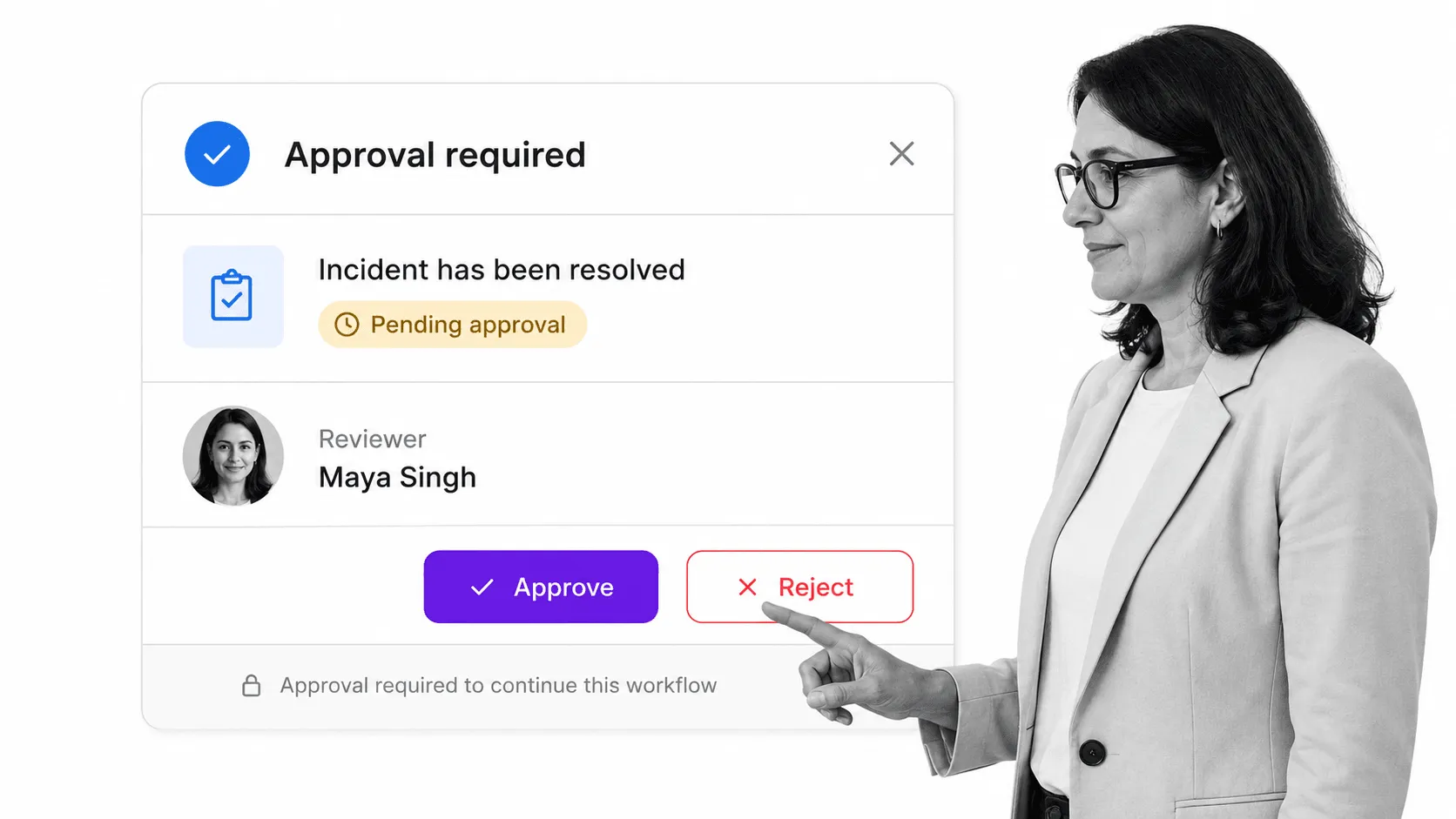
With Process Street’s approvals feature, you can require sign-off on any task that needs authorization before the workflow moves on. Several approval tasks are already built into the templates above, so critical steps like confirming an incident has been resolved or authorizing a deployment cannot be quietly skipped.
Adding your own approvals is simple. Open the workflow in the template editor, add an approval task where you would normally add a task or task header, then choose which tasks require sign-off.
When the tasks under review are complete, the assigned decision-maker opens the workflow run, sees the information captured in those tasks, and approves, rejects, or rejects with a comment so the submitter gets the feedback they need to move forward.
Approve or reject tasks straight from your phone
What is even faster than approving from a browser on your laptop is doing it from your phone’s email app. That lets you make important decisions on the go, whether you are walking into a meeting or in a cab on your way to catch a flight.
4 key benefits of Process Street’s approvals
Here are four of the biggest benefits the approvals feature brings to your IT service management:
- Critical tasks get the oversight they need before work continues.
- Managers and approvers can sign off on items quickly, without chasing anyone down.
- Approval tasks work alongside your other automations, such as conditional logic, dynamic due dates, and task permissions.
- Accountability is built in, which strengthens collaboration across and between teams.
Put approvals to work in your own Process Street workflows and give every high-stakes IT task the oversight it deserves.
Frequently asked questions about ITIL processes
What is the difference between ITIL and ITSM?
IT service management (ITSM) is the overall practice of designing, delivering, and improving the IT services a business relies on. ITIL is the most widely used framework for doing ITSM well: a set of proven processes and practices that give your service management a common structure.
What is the difference between incident management and problem management?
Incident management restores normal service as quickly as possible when something breaks. Problem management looks for the underlying root cause so the same incidents stop recurring. Incident management is the short-term fix, and problem management is the long-term solution.
Is ITIL still relevant now that ITIL 4 is here?
Yes. ITIL 4 reframed the older process-and-lifecycle model into a Service Value System with 34 practices, but the core processes in this guide, from incident and change management through to continual service improvement, remain central to modern IT service management. The names shift (change management became change enablement), but the discipline does not.
How many ITIL processes are there?
The full ITIL v3 framework defines dozens of processes across its five lifecycle stages, but you do not need all of them to see results. This guide focuses on the eight highest-impact ITIL processes that most IT service teams run day to day.
Are these ITIL process templates free to use?
Yes. Every template embedded above is a free, ready-to-run Process Street workflow. Add it to your account, adapt the steps to your environment, and start running your ITIL processes the same reliable way every time.
Other useful resources for managing ITIL processes
Here is a list of articles that are related to ITIL processes. All of them are well worth a read.
- The Secret to IT Service Management: The ITIL Service Lifecycle
- How TechMD Use Process Street to Manage All Their Recurring Processes
- The 11 Agile Processes We Use to Run an Efficient Software Team
- Service Level Management: How to Manage SLAs and OLAs Masterfully
- Best QMS Software for Quality Management Systems: Which is Right for You?
- 17 Service Level Agreement Examples to Track Your Service Management Metrics
- What is an SLA? How to Use Service-Level Agreements for Success
- A Beginner’s Guide to Setting up HR Software in the Cloud
- What is FMEA? A Practical Guide to Failure Analysis (Free Checklist)
- 12 IT Processes to Avoid Server Failures and Client Headaches
- ISO 9001: The Ultimate QMS Guide (Basics, Implementation, ISO Templates)
- Writing as Software: Technical and Automatic Documentation Generation
- When technology actually inhibits workplace productivity
Below is a short video showing how TechMD, an award-winning IT solutions firm specializing in cloud solutions, cybersecurity services, and IT consulting, uses Process Street to create standardized processes that create accountability, provide visibility, track the accuracy of projects, and generate efficiencies.
I hope you find the templates included in this pack useful to improving the way you manage ITIL processes in your organization. Which processes do you think are the most critical, and why? Let us know in the comments below! We are always looking to provide the most valuable templates so your insight may just help us create even better checklists in the future.
The post 8 ITIL Processes for First-Class IT Service Management first appeared on Process Street | Compliance Operations Platform.