











5 Ways to Effectively Manage Remote Teams & Avoid Project Crisis
Blog: Blog | Process Street | Compliance Operations Platform
The following is a guest contribution from Ionia Sima. Ionia is an architecture student, gamer, writer, and CMO of Digital Web Properties. She has a great interest in big data, SEO, SMM, and video animation. You can follow her on X for more random musings.
Remote team management is no longer a side case for companies with a few contractors. Hybrid and distributed work are now normal operating models, which means leaders have to manage trust, communication, goals, and team chemistry without relying on hallway context. To effectively manage remote teams and avoid project crisis, leaders need a practical way to keep small misunderstandings from becoming crisis situations.
The tools have changed since remote work first became mainstream, but the leadership problem has not: people still need context, clear expectations, useful feedback, and a reliable way to see how their work connects to everyone else’s. Gallup’s hybrid work research shows that remote-capable employees largely expect flexibility, while Stanford’s 2025 research found that broad return-to-office mandates are not the universal trend many headlines suggest. Remote management is now a durable leadership skill.
How do you manage people you cannot see? It takes a different set of skills, a new twist to even the most charismatic of leaders, and a comprehensive understanding of human nature. It is part leadership, part marketing, part psychology, part technology. Those elements need to combine in harmony so a team of individuals, each with their own lifestyle, temperament, and work ethic, can coordinate without waiting for face-to-face interaction.
They’re regular employees: treat them like that

Mark Mortensen, an INSEAD professor who studies teams and organizational behavior, has warned managers not to think about remote employees as a fundamentally different class of worker. That point still holds. Remote employees need the same respect, access, clarity, and accountability as the people who sit near you.
The most common failure is creating an invisible divide between people in the office and people working elsewhere. Many companies make the mistake of seeing remote workers as a special case and modifying their approach until it creates separation. The physical distance can create an us-versus-them mentality between your remote team and the one working from the office. Office workers can start assuming remote employees have it easier. Remote workers can feel excluded from decisions, context, and career opportunities. Once that split appears, even ordinary project tension can turn into resentment.
The fix is transparency. Share the same goals, progress updates, decision logs, and ownership expectations with everyone. If the company has a target, remote employees should know the target. If a customer issue is urgent, they should see the urgency. If a handoff is blocked, the blocker should be visible to the whole team, not trapped in a side conversation.
Remote employees may have different working conditions. Some can work in a quiet environment, stay close to their family to help around the house, avoid a draining commute, or make themselves comfortable in a space they chose themselves. Those are obvious perks, and office workers will not ignore them.
That is why leaders need a common purpose. Arvind Sarin, CEO of Copper Mobile, has described the resentment that can spark when office workers believe remote coworkers are rolling out of bed while everyone else has been working since early morning. His answer was to be more open about targets and goals: what the company was doing, what it billed, which clients mattered, how long the work was expected to last, and what the workflow looked like. That kind of transparency can unite your team because everyone has the same destination and understands how their work contributes to it.
Treat those differences as operating context, not as a reason to create two standards. The standard should be the work: what needs to happen, who owns it, when it is due, and what proof shows it is done.
Use multiple communication channels
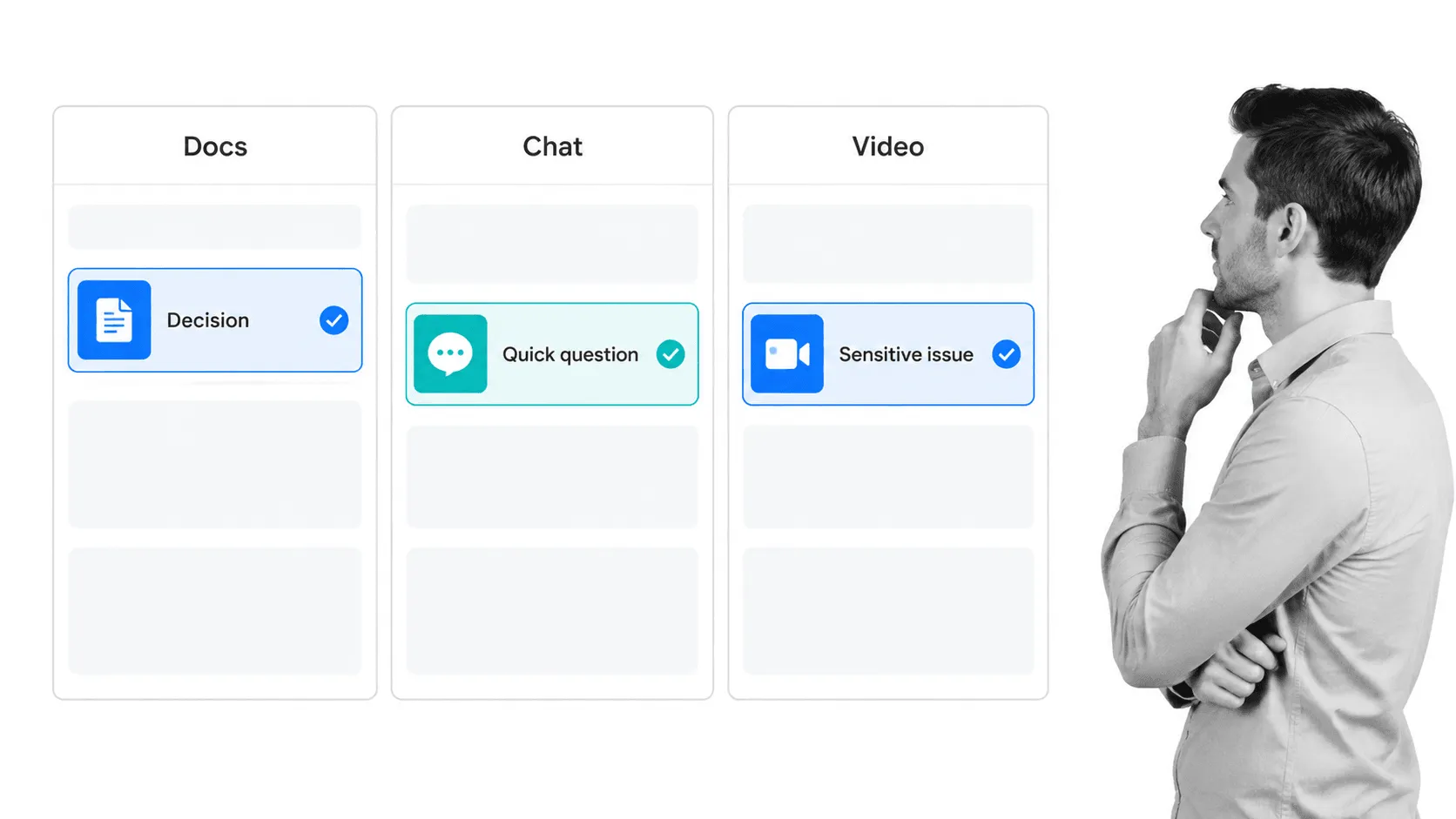
Remote teams do not need more communication. They need cleaner communication. The mistake is pushing every issue into the same channel and expecting people to infer what matters. A quick chat message, a workflow comment, a meeting note, and a decision record do different jobs.
Use chat for fast coordination. Use video or voice for emotionally sensitive, ambiguous, or high-context conversations. Use shared docs for decisions that people need to revisit. Use workflow tools for recurring work where ownership, due dates, approvals, and evidence matter. For a deeper software shortlist, see Process Street’s guide to remote work software.
The practical channel mix still includes Slack, email, comments on shared docs, project boards such as Trello, and video meetings through tools like Google Meet or Zoom. The modern version also adds async updates, recorded walkthroughs, AI summaries, and documented workflows. That matters because remote teams often lose the informal context that co-located teams pick up by overhearing conversations.
Communication is the most obvious obstacle that distance creates. Remote workers are not forced to waste time in traffic, but they also lose the easy clarification that happens when someone can turn around and ask a question. In order to effectively lead remote employees, you need every useful communication channel at your disposal, and you need to make sure each channel has a job.
A simple rule works: if a decision affects future work, document it somewhere durable. If a task has to happen the same way every time, turn it into a workflow. If someone needs nuance, use a meeting or recording. If the issue is urgent but simple, use chat. Channel discipline prevents remote teams from drowning in messages while still missing the decisions that matter.
Video communication and recordings are especially useful when a conversation needs a human touch. A simple call or chat may not be enough to keep attention or reduce misunderstandings. A recorded video conference lets remote employees relive the conversation, revisit major points, and catch details they would otherwise have tried to memorize from meeting notes.
Process Street fits this layer when recurring work needs more than a message thread. Its Compliance Operations Platform brings Docs, Ops, and built-in AI into one product so teams can document procedures, run the work, enforce approvals, and keep audit-ready evidence without asking people to remember every step.
Trust, but verify
Remote management fails when verification becomes surveillance. Activity monitoring may show that someone moved a mouse or opened an app, but it does not prove the right work happened. It can also make good employees feel distrusted, which damages the exact responsibility you are trying to build.
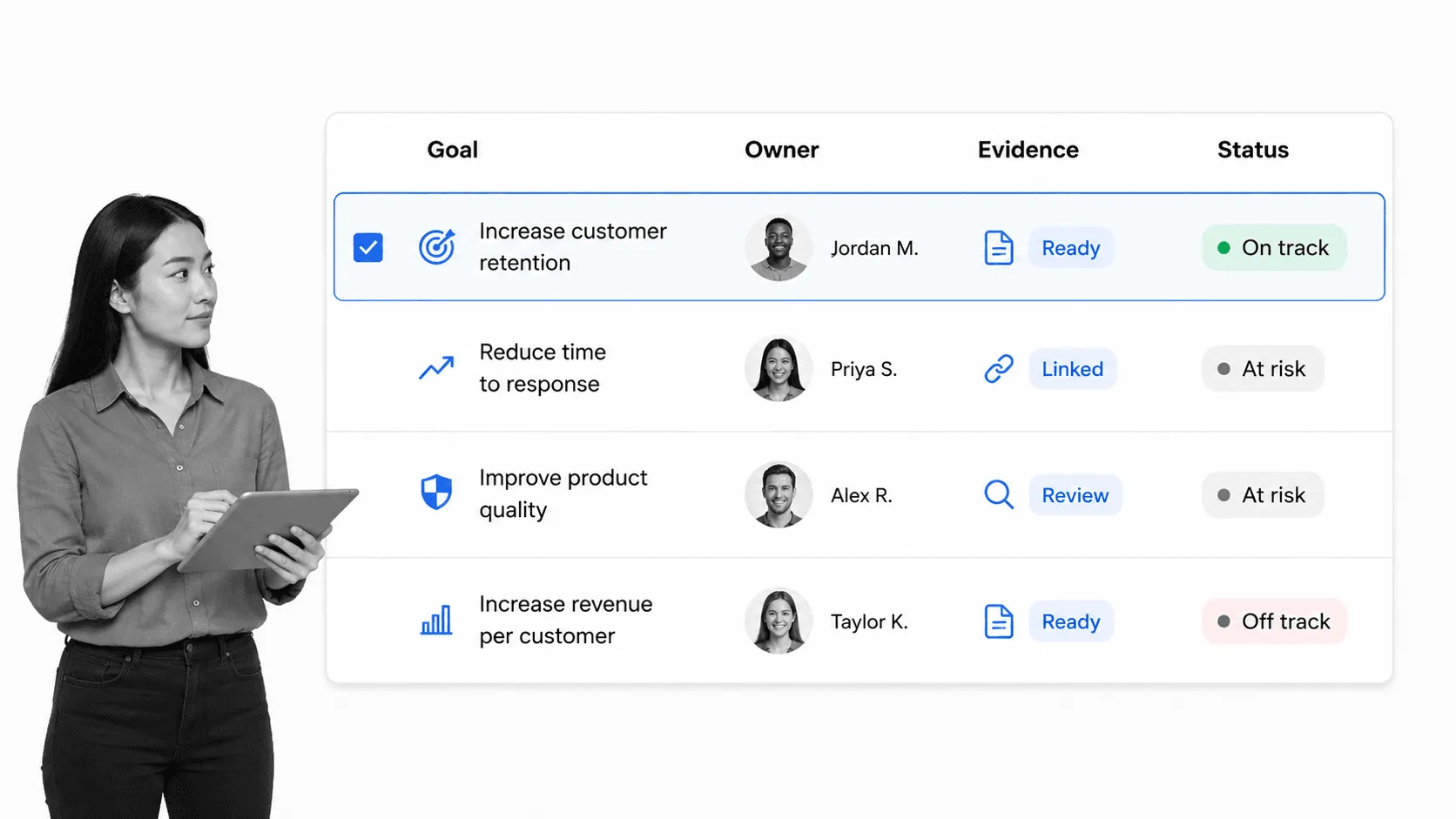
Trust works when expectations are explicit. Your team should know when you are available, what good work looks like, what counts as done, and how progress will be checked. Vague phrases like “do better” or “move faster” do not help remote employees. They need a clear outcome, a deadline, a decision owner, and a place to raise blockers.
The old temptation was to solve the problem with monitoring programs. Those tools can record activity, but they lack the necessary human factor that triggers a genuine sense of responsibility. One piece of software observing work will never equal the watchful eye of a leader who has explained the goal, trusted the person, and created a fair way to check progress.
There is also a balance to keep. Remote employees are often more relaxed and comfortable, and they should be. Happiness and productivity should not become conflicting ideals. To reach the targeted middle, keep three points visible: availability, productivity, and responsibility. People need to know when you are available, what productivity means in the context of their role, and how responsibility will be measured.
Verification should focus on outputs and evidence. Define weekly goals. Review progress against those goals. Ask whether the work produced the required customer, operational, or compliance result. If the work is recurring, use a workflow run, checklist, approval trail, or status board so the proof lives with the work itself.
This also protects managers. Without shared evidence, leaders end up relying on memory, status meetings, and whoever speaks most confidently. With shared evidence, remote employees can work independently while managers still know which handoffs are late, which approvals are stuck, and which risks need attention. Little phrases such as “reach for the stars,” “knock it out of the park,” or “let’s do better, faster” are not what they need. Explain what you mean in a clear and concise manner, devise a plan to reach it, and regularly check on progress.
Gallup’s remote work research captures the tension well: remote workers can be highly engaged while still facing isolation and stress. That is why trust needs structure. The goal is not to watch people harder. The goal is to make the work easier to see.
Make chemistry a high priority
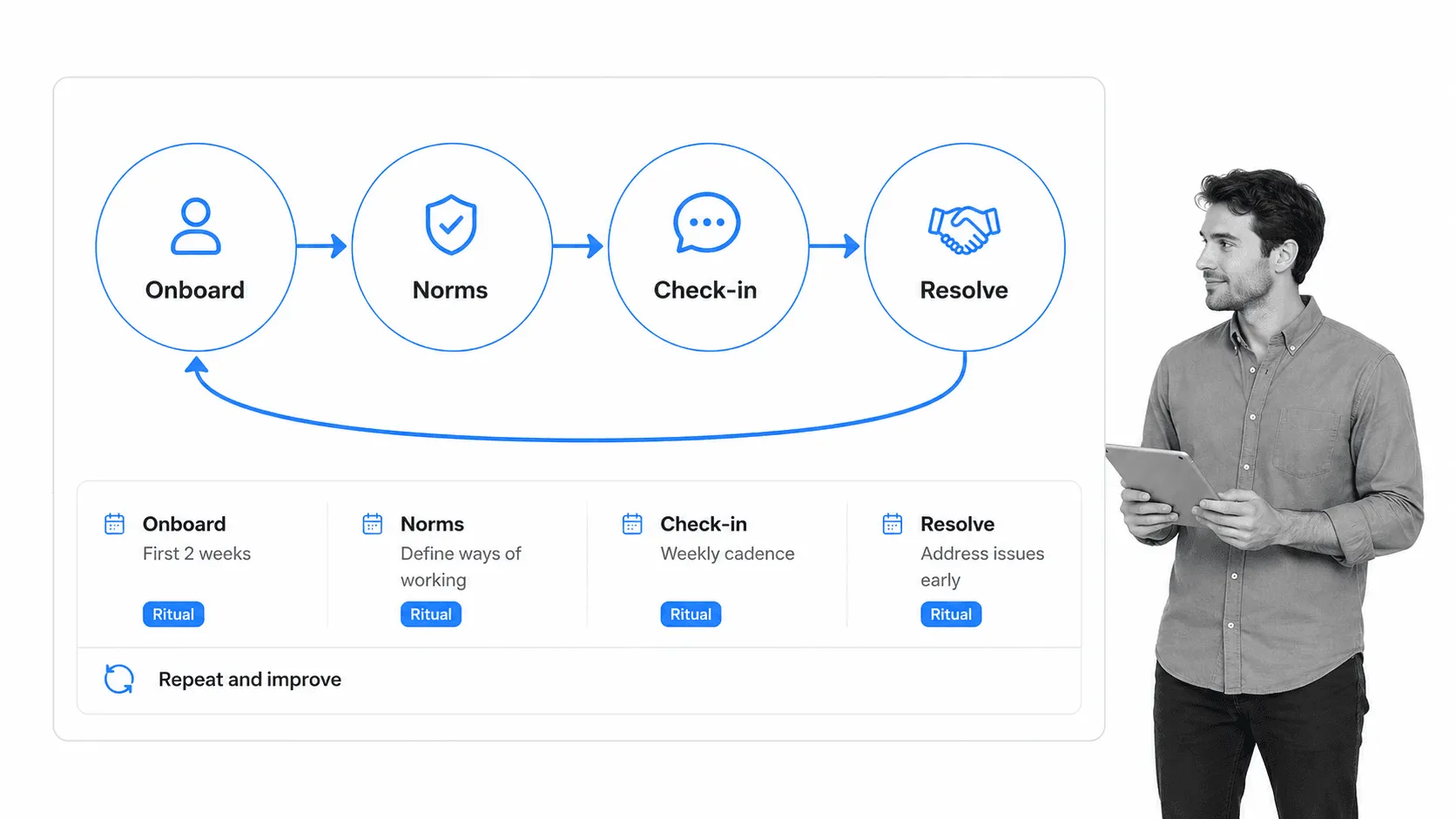
Remote team chemistry does not appear by accident. In an office, people learn small things about each other through repeated informal contact. Distributed teams have fewer of those moments, so leaders need to design the operating rhythm more deliberately.
Chemistry is not about forcing everyone to become friends. It is about trust, context, and working norms. People need to know how teammates prefer to communicate, how decisions get made, how conflict is handled, and when it is acceptable to interrupt someone. Without those norms, stress pushes people into separate directions during deadline pressure, especially when people start panicking about deadlines and drifting toward their own target regardless of other team members.
Build chemistry into the way work happens. Give new remote employees a structured onboarding path. Pair them with people outside their immediate function. Create team rituals that are useful, not performative: weekly priorities, demo sessions, incident reviews, retrospectives, and occasional unstructured time where people can talk without an agenda.
A good relationship between employees is the only thing that can save the situation and maintain teamwork when stress rises. A few rotten apples can destroy a team and dramatically damage its performance, and leaders often notice the problem too late. It can take a while to understand where the problem is and what is not working.
Soft skills still matter, but the better framing is collaboration skill. A remote team needs people who can write clearly, surface risk early, disagree without creating drama, and ask for help before a blocker becomes a crisis. It goes beyond technical capabilities into compassion, intuition, ambition, drive, work ethic, and the other traits that define the success of a project or a team. These skills should be part of hiring, onboarding, and performance conversations, not only a vague culture goal.
When chemistry is strong, crisis moments become easier. People know who to ask, how to escalate, and what information the team needs. When chemistry is weak, the same moment becomes a blame loop. A remote team in sync and with excellent chemistry can solve issues faster than a group of people with similar hard skills and knowledge but no working relationship. Remote leaders cannot prevent every crisis, but they can make the team more resilient before the crisis arrives.
Be the leader, not the boss
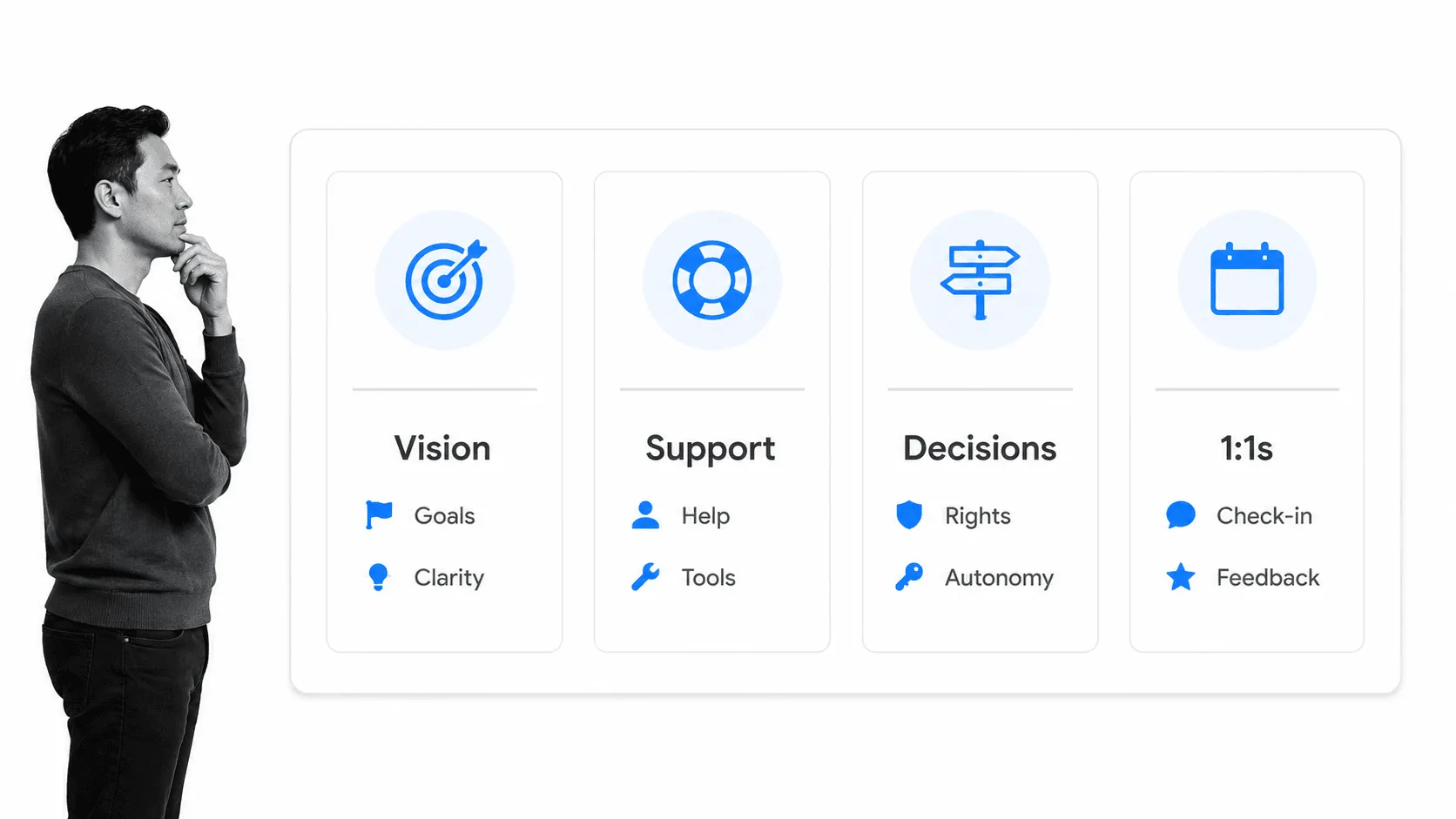
There is a real difference between a leader and a boss. A boss relies on instructions and status checks. A leader helps and teaches by example instead of only ordering. A successful leader will inspire, encourage, correct when needed, show a spirit of collaboration and teamwork, and communicate an engaging vision. Remote teams need that second version.
The old “my door is always open” promise does not translate cleanly to remote work. People cannot walk down the hall for a quick clarification. They may be in another time zone or doing deep work when you are online. If they understand the goal, decision principles, and escalation path, they can move without waiting for you.
Give remote employees regular access to your attention, not constant access to your interruptions. Monthly one-on-ones, useful team meetings, written decision notes, and clear office hours can reduce random pings while still making support predictable. The point is to create independence without isolation.
Group connection still matters. Manon DeFelice, CEO of Inkwell, has described managing a team spread from New York to Washington DC to Minneapolis and using face-to-face moments when they counted. Inviting the team to a pitch meeting and then to a celebratory dinner created a chance to lift team spirit and morale, offer praise, and show appreciation in front of everyone. Remote does not mean people never gather; it means leaders use those moments deliberately.
Leadership also means repeating the vision until it becomes operational. What are we trying to accomplish? What tradeoffs matter? What does good judgment look like when the manager is offline? The clearer those answers are, the less likely the team is to drift during pressure.
One hidden quality leaders should practice is writing. In remote work, the abilities to communicate, smile, and be social increasingly switch to typing out instructions, suggestions, decisions, and appreciation. It is important to improve yourself in order to lead a team of remote workers.
Remote team management is ultimately a discipline of clarity. Treat people equally. Route communication intentionally. Verify outcomes without surveillance. Build chemistry before stress hits. Lead with context instead of control. Do those five things consistently and distance becomes an operating detail, not the cause of your next project crisis.
The post 5 Ways to Effectively Manage Remote Teams & Avoid Project Crisis first appeared on Process Street | Compliance Operations Platform.